Quick Answer
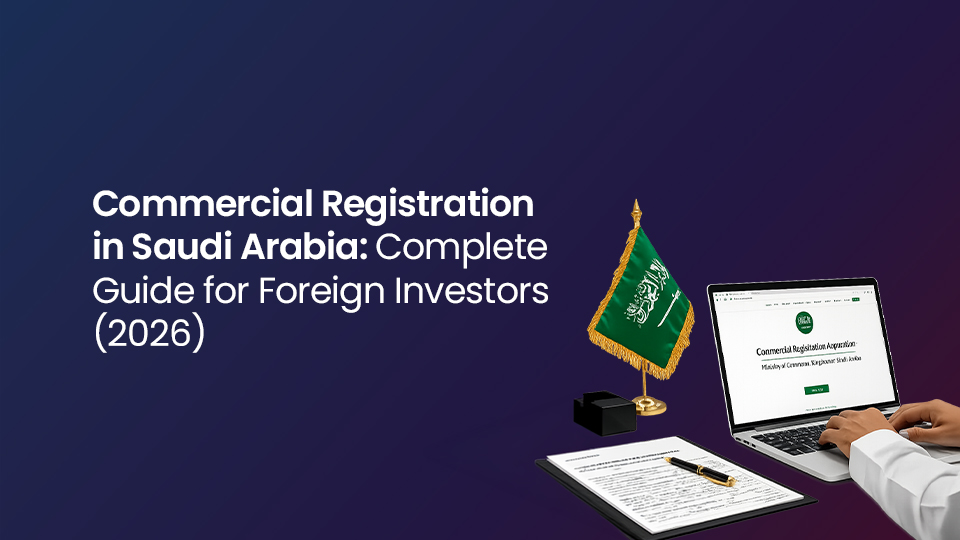
Commercial registration (CR) in Saudi Arabia is the mandatory licence issued by the Ministry of Commerce that gives a foreign company the legal right to operate, sign contracts, and invoice clients inside the Kingdom. Every business — regardless of size or sector — must hold an active CR before commencing commercial activity.
Time to obtain: 2–4 weeks for the CR certificate; 3 months for full operational setup including banking and visas.
Estimated cost: SAR 7,700–15,200 in government fees (MISA licence + CR registration + Chamber of Commerce + notarisation). Professional service fees are additional.
Prerequisite: A MISA (Ministry of Investment) Foreign Investment Licence must be obtained before applying for CR.
Saudi Arabia’s Vision 2030 reforms have transformed the Kingdom into one of the GCC’s fastest-growing investment destinations, with the government targeting USD 100 billion in foreign direct investment by 2030. At the heart of every successful market entry is a single document: the Commercial Registration (CR) certificate.
In 2022, Saudi Arabia introduced a new commercial registration law through Royal Decree M/125, creating a unified CR system, removing expiry dates, and introducing stronger protections for trade names. For foreign investors, these reforms have simplified registration — but they have also introduced new compliance requirements every entity must understand.
This guide covers everything you need: what a CR is, who needs one, which entity structure is right for you, the complete 6-step process, all costs, required documents, and what happens after registration. If you’re exploring business setup in Saudi Arabia for the first time, start here.
Key Facts About Commercial Registration in Saudi Arabia
- It’s mandatory for every foreign-owned business, regardless of size or sector.
- A MISA Foreign Investment Licence must be secured first — CR follows it, not the other way around.
- The typical timeline for the CR certificate itself is 2–4 weeks.
- Total government fees generally range from SAR 7,700 to 15,200, excluding professional service fees.
- An annual confirmation filing is required to keep the CR active — it no longer expires outright.
What Is a Commercial Registration (CR) in Saudi Arabia?
The Commercial Registration (CR), known in Arabic as السجل التجاري (Al Sijil Al Tijari), is a legal document issued by the Ministry of Commerce (MoC) that officially recognises an entity as a legitimate trading entity within the Kingdom of Saudi Arabia.
The CR includes the company name, business activities, registered address, ownership details, and CR number. That CR number is used for banking, invoicing, and government registrations — under Saudi law, no commercial activity may legally commence without an active CR.
The CR is distinct from the MISA Foreign Investment Licence: the MISA licence permits foreign ownership, while the CR is the operational registration that follows from it. You need both.
CR vs MISA Licence: What's the Difference?
| MISA Licence | Commercial Registration (CR) | |
|---|---|---|
| Issued by | Ministry of Investment (MISA) | Ministry of Commerce (MoC) |
| Purpose | Permits foreign ownership/investment | Authorises commercial operations |
| Required for | 100% foreign-owned entities | All entities in KSA |
| Fees | SAR 2,000–5,000 | SAR 1,200/year |
| Expiry | 1 year (renewable) | No expiry (annual confirmation required) |
Who Needs a Commercial Registration in Saudi Arabia?
Any entity carrying out commercial, industrial, professional, or service activities in Saudi Arabia must hold a valid CR — businesses cannot legally trade without one. This includes:
- Foreign companies setting up a subsidiary or branch in KSA
- Joint ventures between foreign and Saudi partners
- Limited Liability Companies (LLCs) with any foreign shareholding
- Foreign companies winning government tenders or entering long-term service contracts in KSA
- E-commerce businesses targeting Saudi consumers
- Professional services firms (consulting, legal, engineering, IT) providing services inside KSA
Exemptions are narrow and sector-specific. If you are operating through a Saudi agent or distributor without a legal presence, you may not need a CR — but any direct presence or contract signing requires one.
Not sure which setup is right for your business? Our entity setup advisory team can review your specific activity codes and recommend the optimal structure.
Business Structures Available to Foreign Investors
Before applying for a CR, you must decide on your legal entity type. The choice affects your tax position, liability, capital requirements, and operational flexibility.
| Structure | Foreign Ownership | Min. Capital | Best For | CR Type |
|---|---|---|---|---|
| Foreign Company Subsidiary | 100% | Determined by activity | Most foreign market entries | Standard CR |
| Branch Office | 100% (parent company) | No minimum | Executing a specific project or contract | Standard CR |
| Limited Liability Company (LLC) | Up to 100%* | SAR 500,000 (some sectors) | Long-term operations, Saudi partnership optional | Standard CR |
| Joint Venture | Varies by agreement | Varies | Large projects, strategic partnerships | Standard CR |
| Professional Company | Up to 75% | Determined by activity | Consulting, legal, engineering, auditing | Standard CR |
*100% foreign ownership is now permitted in the majority of sectors under Vision 2030 reforms, with restricted sectors listed in the MISA Negative List.
The most common structure for foreign market entrants is the Foreign Company Subsidiary, offering full ownership, limited liability, and the widest operational flexibility. Branch offices suit companies executing a specific project or contract rather than establishing a permanent commercial presence.
See our detailed guide: LLC Company Formation in Saudi Arabia for a full comparison of structure options.
Documents Required for Your Commercial Registration
Document requirements vary by entity type, but the checklist below applies to most foreign company structures. All foreign-language documents must be notarised, apostilled where applicable, and translated into Arabic by a certified legal translator.
Documents from the Parent Company (Prepared in Home Country)
- Certificate of Incorporation (notarised + apostille + Arabic translation)
- Memorandum of Association / Articles of Association (notarised + apostille + Arabic translation)
- Board resolution authorising the Saudi entity setup, naming the authorised representative (notarised + apostille + Arabic translation)
- Most recent audited financial statements (last 2 years)
- Good Standing Certificate or Certificate of Incumbency from the home jurisdiction
- Passport copies of all directors and shareholders
Documents to Be Obtained in Saudi Arabia
- MISA Foreign Investment Licence (obtained first, required before CR application)
- Business name reservation certificate (obtained via Ethraa / Ministry of Commerce portal)
- Articles of Association / Memorandum of Association for the KSA entity (signed before notary in KSA)
- Proof of registered address: signed commercial lease agreement or proof of title
- Authorised representative’s Saudi Iqama (residence permit) or passport if non-resident
- Bank reference letter (some cases)
Common delay point: parent company documents must typically be issued within 6 months of the application date. Expired or un-apostilled documents are the single most common cause of CR application delays — ensure all documents are in order before submission.
Analytix’s PRO services team handles document attestation, certified translation coordination, and Ministry of Commerce submissions on your behalf.
The Commercial Registration Process, Step by Step
The process follows six clear steps. Steps 1–2 are prerequisites; Steps 3–6 are the formal registration process with the Ministry of Commerce.
Step 1: Choose Your Entity Structure and Activity Codes
Decide on your legal structure (subsidiary, branch, LLC, etc.) and identify the correct business activity codes from the MISA/Ministry of Commerce approved activities list. Activity codes determine your permitted operations, MISA licence category, minimum capital requirements, and Saudization (Nitaqat) obligations. Getting this right at the outset avoids costly amendments later.
Step 2: Obtain the MISA Foreign Investment Licence (5–7 Business Days)
Foreign companies must obtain a MISA licence before applying for CR. MISA issues eight categories of licence: service, trade, industrial, professional, real estate, agriculture, mining, and entrepreneurial. Businesses submit the application online through the MISA investor portal. Once issued, the MISA licence is valid for one year and must be renewed annually. Full details: MISA Investment Licence in Saudi Arabia.
Step 3: Reserve Your Trade Name (1–3 Business Days)
Reserve your company’s trade name via the Ethraa platform (a Ministry of Commerce portal). Saudi Arabia’s Trade Names Law now permits non-Arabic trade names, allows names to be reserved in advance, and treats registered trade names as assignable business assets. Names must be distinctive, not conflict with registered trademarks, and comply with MoC naming guidelines.
Step 4: Register with the Ministry of Commerce (3–5 Business Days)
Submit the online CR application through the Ministry of Commerce portal (mc.gov.sa) or the Meras one-stop-shop platform. The application requires: company information, trading names, legal structure, planned business activities, owner details, capital documentation, and parent company information. For LLC formation, the full Articles of Association must be notarised and submitted at this stage.
Step 5: Pay Registration Fees
Upon application approval, pay the Ministry of Commerce CR registration fee (SAR 1,200/year under the standard fee schedule) online through the MoC portal. Additional fees apply for Chamber of Commerce membership registration (see costs table below).
Step 6: Collect the CR Certificate
Upon payment confirmation and document verification, the Ministry of Commerce issues the CR certificate — typically as a digital document available immediately on the portal. The CR certificate becomes the foundation document for all subsequent registrations, bank account opening, and Iqama applications.
Summary timeline: MISA licence (5–7 days) + name reservation (1–3 days) + MoC registration (3–5 days) + Articles of Association notarisation (3–5 days) ≈ 2–4 weeks for the CR certificate. Full operational setup (banking + Iqama + portals) typically takes 3 months.
CR Fees and Costs in Saudi Arabia
Unlike most competing guides, we give you real numbers. Below are the government fee components that apply to most standard foreign company setups in 2026. Professional service fees for document preparation, translation, and submission support are additional.
| Fee Item | Amount (SAR) | Notes |
|---|---|---|
| MISA Foreign Investment Licence | 2,000 – 5,000 | Varies by licence category; annual renewal |
| Ministry of Commerce CR Registration | 1,200 | Per year; required under new CR Law |
| Chamber of Commerce (CoC) Membership | 1,500 – 2,500 | Mandatory; varies by capital size |
| Document Notarisation & Attestation | 1,500 – 3,000 | Home country + Saudi notary |
| Certified Arabic Translation | 1,000 – 2,000 | Per document set; varies by volume |
| Articles of Association Notarisation (KSA) | 500 – 1,500 | Required for LLC structure |
| TOTAL ESTIMATED GOVERNMENT FEES | 7,700 – 15,200 | Before professional service fees |
Minimum capital requirements vary by activity. Most service and consulting activities have no mandatory minimum capital requirement for foreign subsidiaries. Industrial and financial sector activities typically require SAR 500,000–5,000,000 in registered capital, which must be evidenced but is not a government fee.
Exchange rate note: for GCC-based investors, 1 SAR ≈ 0.27 USD / 0.98 AED at time of publication.
How Long Does the Process Take?
Below is a realistic week-by-week timeline for a standard foreign company subsidiary incorporation, assuming documents are prepared correctly before submission. Document errors — especially un-apostilled certificates or expired Good Standing letters — are the main cause of delays.
| Week | Milestone | Notes |
|---|---|---|
| Week 1 | Document preparation + MISA licence application | Parent company documents gathered, translated, notarised, apostilled. MISA application submitted. |
| Week 1–2 | MISA licence issued | 5–7 business days from submission. Delays rare if documents are correct. |
| Week 2 | Trade name reservation | 1–3 business days via Ethraa portal. |
| Week 2–3 | MoC CR application submitted + AoA notarised | 3–5 business days for MoC review. Simultaneous AoA notarisation if LLC. |
| Week 3–4 | CR certificate issued + CoC registration | CR issued upon fee payment. CoC registration follows immediately (1–2 days). |
| Month 2 | GOSI + ZATCA + national address + bank account | Post-CR compliance registrations. Bank account opening 2–6 weeks depending on the bank. |
| Month 3 | GM Iqama + government portals + Saudization | Iqama for General Manager; Muqeem, Absher, Qiwa, Mudad portals; Saudization plan implemented. |
| Month 3+ | Fully operational | Companies can hire, invoice, and operate under full compliance. |
What Happens After You Receive Your CR?
Obtaining the CR is the end of Stage 1 of the Saudi market entry journey. Stage 2 — the “soft landing” phase — involves a series of post-CR registrations that must be completed before the company is fully operational and compliant.
Mandatory Post-CR Registrations
- Chamber of Commerce (CoC) registration: mandatory immediately after CR issuance. Required for certificates of origin, trade documents, and government tenders.
- National Address registration: required by Saudi Post (SPL). Mandatory for all commercial entities; the national address is used across all government portals.
- GOSI registration: registration with the General Organisation for Social Insurance is required before hiring any employees. GOSI contributions: 12% employer / 10% employee for Saudi nationals.
- ZATCA registration: registration with the Zakat, Tax, and Customs Authority for corporate tax (20% for foreign entities) and VAT (15% where applicable).
- Bank account opening: required under the new CR Law (all CRs must be linked to an active bank account). Allow 2–6 weeks depending on the bank and KYC process.
- Iqama (residency permit) for the General Manager: the GM of the Saudi entity must hold a valid Iqama. Processing time: 2–4 weeks.
- Government portal registrations: Muqeem (expatriate management), Absher (resident services), Qiwa (labour relations), Mudad (salary protection). All mandatory for companies with employees.
- Saudization (Nitaqat) compliance: Saudi nationals must make up a minimum percentage of your workforce, varying by company size and sector. Non-compliance restricts visa issuance.
Analytix manages the full post-CR compliance journey. Our GRO services team handles GOSI, ZATCA, and all government portal registrations, while our accounting team ensures your financial compliance from day one.
Key Changes Under the 2022 Saudi Commercial Registration Law
Royal Decree M/125 (2022) introduced the most significant reforms to the CR framework in the Kingdom’s history. Foreign investors should understand five key changes:
| Change | What It Means for Foreign Investors |
|---|---|
| Unified CR system | One CR covers all your business activities — no more separate CRs per activity or branch. |
| No expiry date (annual confirmation) | CRs no longer expire but require annual confirmation of company information. Failure to confirm risks suspension. |
| CR revoked after 1 year of inactivity | If your company ceases operations, the CR is cancelled within 12 months (previously 30 days' notice). Plan any market exit accordingly. |
| Non-Arabic trade names permitted | Foreign companies can now register and use their international brand name directly — no forced Arabic transliteration. |
| Bank account mandatory | Every CR must be linked to an active Saudi bank account. This is now a compliance requirement, not just a commercial convenience. |
| 5-year grace period (existing companies) | Companies with legacy multiple CRs across branches have 5 years to consolidate to the unified system. |
How Analytix Helps You Register Your Business in Saudi Arabia
Analytix is a Riyadh-based entity incorporation and compliance firm. Our commercial registration work is led by consultants with 17+ years of experience and a track record spanning 8+ countries, supporting foreign investors from initial entity selection and MISA licensing through to post-CR compliance and ongoing government relations.
Case Study 1: UAE Software Company
Challenge:
A software company from the UAE wanted to open a business in Saudi Arabia but was unfamiliar with the commercial registration process and unsure which documents the Ministry of Commerce would require.
Solution:
- Reviewed the right business structure for the company’s activity
- Prepared and checked all required documents
- Managed government approvals and the CR application end to end
- Supported the company through to certificate issuance
Result:
The CR was issued within Analytix’s standard 2–4 week timeline, with no delays caused by documentation errors, and the company was able to begin serving Saudi customers on schedule.
Case Study 2: European Manufacturing Company
Challenge:
A European manufacturer expanding into Saudi Arabia needed guidance on the registration process, complicated by a larger shareholder base that made document collection more demanding.
Solution:
- Built a clear registration plan around the multi-shareholder structure
- Collected and reviewed documentation from each shareholder
- Managed the Ministry of Commerce registration process and required approvals
Result:
The company completed commercial registration and began operations on schedule, entering the Saudi market with full compliance despite the added shareholder complexity.
What Our Commercial Registration Service Includes
- Entity type advisory — recommend the right structure for your sector, activity, and ownership goals
- MISA licence application and follow-up with the Ministry of Investment
- Trade name search and reservation via the Ethraa portal
- Document collection checklist, notarisation coordination, and Arabic translation management
- Ministry of Commerce CR application submission and tracking
- Articles of Association drafting and KSA notarisation
- Chamber of Commerce registration
- Post-CR: GOSI, ZATCA, national address, bank account introduction, government portal setup
- Ongoing Iqama management, licence renewals, and Saudization compliance support
Need a CR for an industrial or manufacturing operation? See our guide to the Industrial Licence in Saudi Arabia, which covers the additional MISA industrial licence requirements and factory setup approvals.
Ready to get started? Analytix’s commercial registration team can have your MISA application submitted within 5 business days of receiving your documents. Contact us for a free initial assessment.
Commercial registration is the legal foundation of every foreign business operating in the Kingdom. While the process has become faster under Vision 2030 reforms, investors must still complete several important steps — obtaining a MISA licence, registering with the Ministry of Commerce, and meeting post-registration compliance requirements. With the right support, most companies complete commercial registration in Saudi Arabia within 2–4 weeks and become fully operational within approximately three months. Analytix assists foreign investors throughout the entire process, from entity selection and licensing to ongoing compliance and business support.
- FAQs
Frequently Asked Questions
The following questions cover the most common queries we receive from foreign investors about commercial registration in Saudi Arabia.
How long does commercial registration take in Saudi Arabia?
The CR certificate itself typically takes 2–4 weeks from document submission to issuance, assuming all documents are correctly prepared. This includes 5–7 days for the MISA licence, 1–3 days for name reservation, and 3–5 days for the Ministry of Commerce registration. Full operational incorporation — including bank account opening, GM Iqama, and government portal registrations — typically takes 3 months.
How much does commercial registration cost in Saudi Arabia?
Government fees for a standard foreign company incorporation range from SAR 7,700 to SAR 15,200 (approximately USD 2,050–4,100). This includes the MISA licence (SAR 2,000–5,000), Ministry of Commerce CR fee (SAR 1,200/year), Chamber of Commerce membership (SAR 1,500–2,500), and document notarisation and translation (SAR 2,500–5,000). Professional service fees for an entity setup firm are additional and vary by scope.
Can a foreign company have 100% ownership in Saudi Arabia?
Yes. Under Vision 2030 reforms, 100% foreign ownership is permitted in the majority of sectors. Restricted sectors — where a Saudi partner is required or foreign ownership is capped — are listed in the MISA Negative List. Most service, technology, consulting, trading, and manufacturing sectors are fully open to 100% foreign ownership.
Do I need a Saudi partner to register a company?
No. In most sectors, a Saudi partner is no longer required. The requirement for a Saudi partner (previously 25% minimum) was removed for the majority of business activities under Vision 2030 investment reforms. A Saudi partner may still be required in certain regulated sectors (e.g., some defence, legal, and media activities). Your specific activity codes determine the ownership structure requirements.
What is the difference between a branch office and a subsidiary in Saudi Arabia?
A subsidiary is a separate legal entity from the parent company, offering limited liability protection to the parent. A branch office is an extension of the parent company, which bears full legal liability for the branch’s obligations in KSA. Subsidiaries are preferred for long-term market presence; branches suit companies executing a specific contract or project. Both require a MISA licence and a CR.
Does the commercial registration expire in Saudi Arabia?
Under the 2022 Commercial Registration Law, CRs no longer have an expiry date. However, companies must complete an annual confirmation of their CR details (business activities, address, ownership information) through the Ministry of Commerce portal. Failure to confirm annually can result in suspension. The MISA licence, however, still requires annual renewal (separate from the CR).
What happens if a company stops operating — can the CR be cancelled?
Yes. Under the 2022 CR Law, if a company ceases all commercial activity, its CR is revoked by the Ministry of Commerce after 12 months of inactivity — extended from the previous 30-day period. If you are planning a market exit or company closure in KSA, formal deregistration is strongly recommended over simply allowing the CR to lapse, to avoid ongoing compliance obligations and potential penalties.