
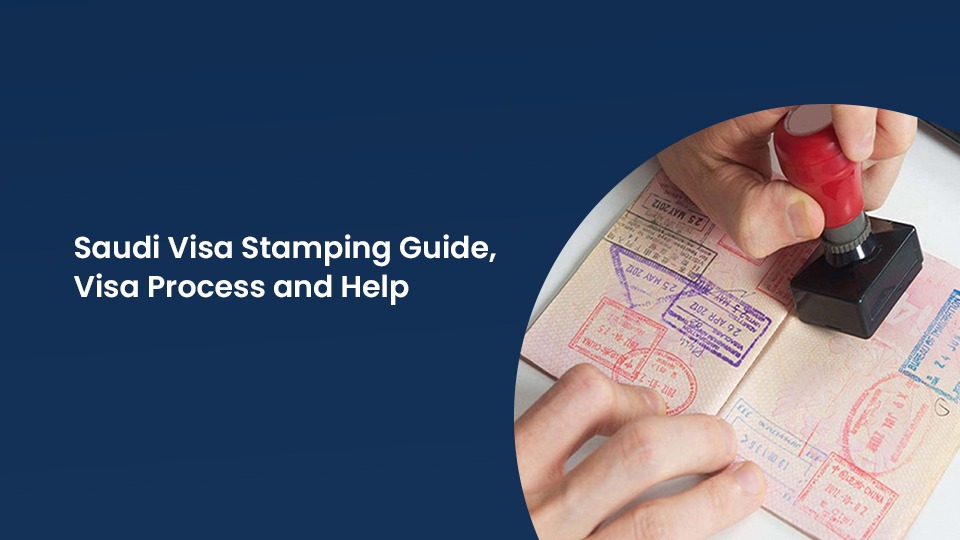
Saudi visa stamping is a mandatory procedure for entering Saudi Arabia which implies verification of documents and endorsement by the embassy. The blog describes the importance of visa stamping, lists general and visa-specific document requirements, the stamping procedure, where the documents should be submitted, charges, fees, and expert advice on avoiding delays, which will guide the travelers on making entry into the Kingdom, smooth and legally compliant.
In this blog, we’ll explain clearly the steps involved in Saudi visa stamping and answer frequently asked questions while outlining some tips in relation to avoiding last minute stress. We aim to ease your travel to the Kingdom as much as we can.
So let’s get started!
Introduction in Saudi Visa Stamping
Are you planning to travel to Saudi Arabia for employment, family reunification, business meetings or religious reasons? Saudi visa stamping is one of the important final procedures before departure. Although most of the applicants are granted a visa through a Saudi sponsor and assume that the process is complete, the fact is that entry to the Kingdom is only granted when the visa is stamped on the passport by an official Saudi Embassy or Saudi Consulate.
Saudi visa stamping is not just one of the formalities. It is a compliance verification phase that will make sure that all legal, administrative, and health requirements are met accordingly with Saudi immigration and labor regulations. Since there are varying requirements in documents based on the category of visa, nationality, and profession, the process can be overwhelming when a person lacks a clear guideline on what to do.
This guide has been developed by the visa documentation experts, who have been working with the Saudi embassy submission guidelines, the Ministry of Foreign Affairs (MOFA) authorization procedures, and the multi-tier attestation chains of the documents, which include the Embassy – MOFA – Chamber of Commerce legalizations. The provided insights are based on the practical experience in managing employment, family, and business visa documentation across multiple jurisdictions.
Whether you are the employer onboarding foreign employees or an individual planning for relocation, the proper understanding of visa stamping process can prevent cost delays and rejections.

Overview of Saudi Visa Stamping
Saudi visa stamping is the final phase of authorization required before a foreign national legally entering Kingdom of Saudi Arabia (KSA). It starts with the Saudi sponsor making an application and obtaining a visa authorization code issued by the Saudi Ministry of Foreign Affairs (MOFA). This authorization assures that the visa request has been registered with the immigration system of Saudi Arabia.
But this approval does not allow travelling. The applicant has to send necessary documents to the Saudi Embassy or Consulate in his/her country of residence for a physical visa endorsement in the passport.
The stamping stage verifies:
- Legitimacy of authorization of visas.
- Adherence to health regulations
- Proper attestation of a documents
- Sponsor legitimacy
- Identity confirmation
Various types of visa like employment visas, family visit visas, business visas and religious visas have different levels of documentation requirements. Furthermore, certain professions and nationalities may require police clearance, degree certification, or even medical examinations.
The applicant can make the travel arrangements, only after the embassy stamps the visa in the passport.
The last step in the process of traveling to Saudi Arabia is visa stamping. Only after successful visa stamping can the holder commence travel plans and enter the country based on the validity and regulations of the stamped visa.

Whether Saudi Visa Stamping is Important?
The visa stamping is Kingdom’s external compliance checkpoint before entry. Although a visa authorization number may be issued electronically, airlines and immigration authorities need physical visa endorsement in the passport before allowing a person to board.
Saudi Arabia has well-organized visa controls to:
- Protect national security
- Keep track of entry of foreign workforce.
- Authenticate sponsor-employer relationships
- Ensure adherence to Public health Regulations
- Confirm authenticity of legal documents
In the case of employment-based applicants, the visa stamping is done to verify that the employment contract, education qualifications and sponsor documentation are in accordance with the Saudi labor laws.
For e.g., multinational companies like SABIC requires employees to complete visa stamping prior to their onboarding in Saudi Arabia to ensure that they are in total compliance with regulations.
Entry into the Kingdom is not possible without visa stamping, regardless of prior authorization.
Applicants can only start planning their travel and prepare to live and work in Saudi Arabia after successful visa stamping.
Furthermore, visa stamping aids in the control of the movement of expatriates into the Kingdom and assists the government in achieving its objectives of protecting national security and the integrity of the labor market. It, verifiably, safeguards the interests of both the employer and employee by ensuring all contractual and legal provisions are properly documented and recognized.
So Saudi visa stamping serves as more than just a procedural formality; it is a legal prerequisite which must be observed to ensure compliance with the regulatory framework of the Kingdom, accomplish business activities by companies like SABIC, and ensure orderly and secure entry for holders of all types of visas.

Documents Required for Saudi Visa Stamping (General Checklist)
Even though some of the requirements might vary depending on the jurisdiction of the embassy, the following documents are generally required:
- Original Passport
Should have a minimum of six months of validity and a pair of blank pages. - Visa Authorization Copy
Certified and issued by Saudi MOFA confirming the approved sponsor request. - Sponsor Invitation Letter
Should be attested by Saudi Chamber of Commerce and MOFA. - Passport-Sized Photographs
White background, recent, and matching Saudi specifications. - Medical Report ( For Employment and Family Visas)
The medical tests should be done in centers approved by GAMCA and accepted by the Saudi governments. The report usually stands valid for a period of three months.
This requirement is to ensure that applicants meet Saudi public health standards before entry. - The Police Clearance Certificate (PCC)
Should be provided and approved by applicant’s local police and certified by MOFA and the Saudi Embassy.
This support Saudi security screening procedures. - Educational Certificates (Employment Visa)
The degree and diploma certificates should pass through due attestation chain:
Notary –Ministry of Foreign Affairs-Saudi Embassy. - Employment Contract
Signed and authenticated. - Attestation of Chamber of Commerce.
Ensures the validity of the employer paperwork and sponsor authenticity. - Visa Application Form
Complete accuracy with no discrepancies. - Iqama Copy (For Family Visa Applications)
Offered by the sponsor who resides in Saudi Arabia.
Document Validity & Attestation Overview
| Document | Issuing Authority | Attestation Required | Typical Validity Period |
| Passport | National Authority | No | 6+ months |
| Visa Authorization | Saudi MOFA | No | As per visa |
| Medical Report | GAMCA | No | 3 months |
| Police Clearance | Local Police | MOFA + Embassy | 3–6 months |
| Academic Certificates | Academic Institution | Multi-level | Permanent |
| Marriage/Birth Certificate | Civil Authority | MOFA + Embassy | Permanent |

Specific Saudi Visa Types & Documentation Differences
Employment Visa
Requires:
- Employment contract
- Degree certificates
- Experience letters
- Medical examination
Most complex documentation due to the labor compliance requirements.
Family Visit Visa
Requires:
- Marriage certificate
- Birth certificates
- Sponsor Iqama copy
Moderate complexity in documentation.
Business Visa
Requires:
- Letter of invitation from Saudi company.
- Copy of commercial Registration.
Usually medical tests is not mandatory.
For more information, refer to our Saudi Visa Types guide.
Comparison of Visa Documentation
| Visa Type | Additional documents | Medical required | Attestation level |
| Employment | Contract, Degree | Yes | High |
| Family Visit | Marriage/Birth | Sometimes | Moderate |
| Business | Company Invitation | No | Low |

Saudi Visa Stamping- Step by Step Process
Step 1: Receive Visa Authorization of MOFA.
The Sponsor approves Visa approval from MOFA.
Step 2: Document Preparation and Attesting.
Any documents that are needed should be duly legalized.
Pro Tip: Complete full document attestation prior to appointment of GAMCA medicals to avoid medical expiry during delays
Step 3: Medical Examination
Complete testing at certified GAMCA center.
Step 4: Submission through Authorized Agent
Applications are channeled through centers that are approved by the embassy. .
Step 5: Pay Visa Fees
The charges are dependent on the type of visa and nationality.
Step 6: Track Application
Applicants can track status through one of the authorized agency or MOFA systems.
Step 7: Accept Stamped Passport.
Once stamped, on can proceed with the travel.

Where to Submit Documents
The applicants must submit the required documents through the approved visa processing centers of Saudi Embassy. Direct submission through embassy is normally not permitted.
Authorized centers verify:
- Attestation chain
- Sponsor documentation
- Application completeness
- Fee payment compliance
Please confirm that the chosen agency is a legally established one.

Tips for a hassle free Saudi Visa Stamping.
- Check embassy requirements.
- Arrange documents in the sequence.
- Double check on attestation order.
- Book medical examinations in advance.
- Do not make incorrect matching entries.
- Use authorized agents only
- Keep duplicated records/scanned copies of every document.
- Stamping should be done as soon as the visa is approved.
The visa stamping practices at Saudi embassies might be a bit different depending on the jurisdiction of the embassy and revised policies by MOFA. Always verify current instructions before submission.
Examples of Visa Stamping Delays and Rejections.
- Incorrect order of attestation.
- Expired medical report
- Mismatch of photo specification.
- Passport damage
- Discrepancies in sponsor information.
- Unverified employer documentation.
Even minor clerical discrepancies can lead to rejection.

Need Help with Saudi Visa Stamping?
The Saudi visa stamping involves organized regulatory checks and strict documentation compliance. Analytix has supported hundreds of applicants with , family, and business visa application, which has facilitated smooth embassy processing.
Our Services include:
- Document verification
- Coordination of certificate attestation
- Embassy liaison
- Application monitoring
- Regulatory compliance support
With our expert handling, the applicants can reduce the risk of rejection and receive their approvals on time.
Conclusion
We hope you have got a detailed idea on Saudi Visa Stamping.
It is mandatory well-structured compliance process to be completed before entering the kingdom. Whether you are applying employment, family, or business purposes, it is important to prepare th documents cautiously and follow the processes of attestation in order to be given a go-ahead.
Due to the possibility of the changes of Saudi embassy requirements and MOFA policies, applicants are advised to confirm the latest embassy-specifications prior to submission.
The right planning will make your entry to Saudi Arabia, smooth and worry-free.