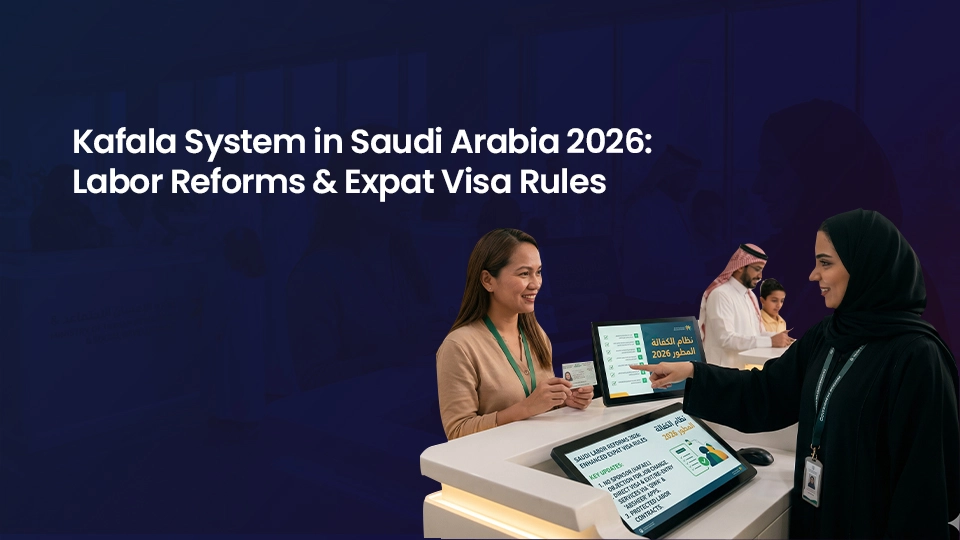
Kafala System in Saudi Arabia 2026: Labor Reforms & Expat Visa Rules
If you employ expatriate staff in Saudi Arabia or you are an expat working there, the rules that governed your working life for the past 70 years no longer apply. In June 2025, Saudi Arabia formally abolished the Kafala system, ending a sponsorship framework that tied foreign workers’ legal residency and job mobility to a single employer’s approval.
The reform replaced employer-controlled residency with a formal, contract-based employment model. Workers may now change employers, depart the country, and access legal protection without their sponsor’s approval. For foreign nationals and organisations currently operating in the Kingdom, or those considering business setup in Saudi Arabia, this is the most consequential Saudi Arabia labour law reform 2025 has produced — with direct and immediate implications for workforce planning, employment contracts, and operational compliance.
This guide provides a comprehensive overview of what changed, what it means for expatriate workers, and what businesses must do to remain compliant under the new framework in 2026.
What Was the Kafala System in Saudi Arabia?
DIRECT ANSWER
The kafala system in Saudi Arabia was a Gulf employer-sponsorship model under which a foreign worker’s legal residency and right to change employment were tied directly to a named sponsor. The worker could not transfer to a new employer, exit the country, or access legal protection without that employer’s written consent.
What Does Kafala Mean?
Kafala (كفالة) is an Arabic word meaning “sponsorship” or “guarantee.” In the context of Gulf labour law, it referred to a system under which a foreign worker’s legal right to reside and work in the country was tied directly to a local employer, known as the kafeel, who acted as their legal sponsor and bore legal responsibility for their conduct and residency status.
- Workers could not change employment without a written No Objection Certificate (NOC) from the current employer
- Departure from Saudi Arabia required an exit visa approved by the kafeel
- Employers could legally cancel a worker’s residency, creating immediate deportation exposure
- Passport confiscation, while prohibited, was a widespread practice with limited accountability
- Workers faced significant barriers to accessing labour courts or formal legal recourse
KEY FACT Approximately 15 million migrant workers — over 40% of Saudi Arabia’s total population — were subject to the Kafala system. The International Labour Organization (ILO) and multiple human rights bodies consistently characterised the framework as incompatible with international labour standards. Source: HRSD Annual Labour Market Report & ILO GCC Labour Migration Working Paper.
What Replaced the Kafala System in Saudi Arabia?
Saudi Arabia replaced the Kafala sponsorship model with a formal, contract-based employment framework administered through the government’s digital Qiwa platform. All employment relationships are now registered digitally, with workers granted direct access to labour protections and dispute resolution mechanisms, independent of their employer’s approval.
The reform was implemented as a central component of Crown Prince Mohammed bin Salman’s Vision 2030 modernisation agenda, driven by three main reasons: the need to attract sustained foreign direct investment, mounting international pressure from the ILO and foreign governments, and the precedent established by Qatar’s Kafala reforms ahead of the 2022 FIFA World Cup. Saudi Arabia, scheduled to host the 2034 World Cup, acted decisively to pre-empt comparable international scrutiny.
New Entitlements for Workers Under the 2025 Framework
- Job mobility: workers may transfer to a new employer freely once contractual obligations or the applicable notice period are met
- Exit rights: departure and re-entry visas may now be applied for directly via Absher or Qiwa, without sponsor approval
- Passport protection: employers are explicitly prohibited from retaining workers’ passports
- Legal access: labour courts may be accessed to report wage theft, contract violations, or workplace misconduct without risk of deportation
- Digital contracts: formal employment agreements via Qiwa replace all informal sponsorship arrangements
Kafala System vs. New Contract-Based System: What Changed?
| Area | Under Kafala (Before 2025) | New Contract System (2025 Onwards) |
|---|---|---|
| Job Change | Required employer's written NOC | Permitted freely after contract or notice period |
| Exit Visa | Required employer's approval to depart Saudi Arabia | Applied directly via Absher/Qiwa; no sponsor required |
| Passport | Frequently retained by employers (illegal but pervasive) | Explicitly prohibited; workers retain their own passport |
| Contracts | Often informal or verbal | Formal digital contracts registered on the Qiwa platform |
| Legal Recourse | Limited; fear of deportation discouraged complaints | Labour courts accessible without deportation risk |
| Employer Control | Employer could cancel residency at will | Employer authority confined to contractual obligations only |
Based on HRSD official guidelines and Vision 2030 labour reform documentation as of 2026.
FROM THE ANALYTIX ADVISORY DESK
In practice, the most immediate challenge we are seeing for businesses operating in Saudi Arabia is not legal compliance; it is retention. Organisations that previously relied on the structural immobility of their workforce are now losing skilled employees within 90 days of contract completion. Companies that have proactively renegotiated compensation and formalised career progression frameworks are retaining far better. The reform is not just a legal change — it is a market dynamic shift. Businesses that treat it as a paperwork exercise are already falling behind.
Is Your Business Compliant With Saudi Arabia’s New Labour Framework?
If your employment contracts still reference Kafala-era terms or lack Qiwa registration, your business is exposed. Our GRO and PRO advisors can review your current documentation and confirm compliance, typically within 5 working days.
Is the Kafala System Completely Gone in Saudi Arabia?
SHORT ANSWER
Yes for private sector workers — with phased coverage for domestic workers.
As of June 2025, Saudi Arabia formally abolished the Kafala sponsorship framework for private sector expatriate employees. Employer authority over workers’ residency status, travel rights, and job mobility has been removed. However, the reform is being implemented in phases:
- Private sector employees on formal Qiwa-registered contracts: full coverage from June 2025
- Domestic workers (household staff, drivers, caregivers): subject to a separate implementation schedule with distinct eligibility criteria
- Government sector workers: governed by distinct employment regulations outside this reform
- Workers on informal arrangements: encouraged to formalise contracts via Qiwa to access protections
⚠ Important: Workers in the domestic category should verify their specific eligibility directly through the Ministry of Human Resources and Social Development (HRSD) portal at hrsd.gov.sa, or consult a registered PRO services provider in Saudi Arabia.
How Does the New Saudi Employment Process Work? (Step-by-Step)
For expatriate workers transitioning under the reformed framework, the process works as follows:
- Sign a formal employment contract with your employer. The contract must be registered on the Qiwa platform before it is legally valid.
- Receive your Iqama (residency permit) — now tied to the employment contract, not to a named sponsor.
- To change employer: serve your contractual notice period. Once complete, initiate the transfer directly via Qiwa. No NOC from your current employer is required.
- To travel outside Saudi Arabia: apply for an exit or re-entry visa via the Absher platform. No employer approval is needed.
- If a dispute arises: file directly with the Saudi Labour Court via Qiwa. Workers may do this without employer consent and without risk of immediate deportation proceedings.
- Passport: your employer is legally prohibited from holding your passport at any point during your employment.
⚠ Important: Domestic workers and certain employment categories may operate under phased timelines. Verify your specific eligibility via the HRSD portal before initiating any job transfer.
What Happens to Existing Contracts Signed Under the Kafala System?
This is one of the most common questions from employers currently operating in Saudi Arabia. The answer is unambiguous: all existing employment contracts, including those signed before the June 2025 abolition, are now subject to the new framework.
- Kafala-era sponsorship clauses are no longer enforceable. Employers cannot legally use pre-reform contract terms to restrict worker mobility.
- Workers employed under old contracts retain full rights under the new system, including the right to change employer, apply for exit visas independently, and access labour courts.
- Employers must update non-compliant contracts to remove sponsorship language and register updated agreements on the Qiwa platform.
- Failure to update contracts does not void the employment relationship, but it exposes employers to regulatory scrutiny and potential penalties under the updated Saudi Labour Law.
ACTION REQUIRED
If your business has not yet reviewed and updated its employment contracts to reflect the 2025 reforms, this is the most urgent compliance action required in 2026. The Analytix GRO team conducts full employment documentation reviews across KSA workforces — typically completed within 10 working days. Contact us at analytix.sa/contact.
What Happens to Existing Contracts Signed Under the Kafala System?
This is one of the most common questions from employers currently operating in Saudi Arabia. The answer is unambiguous: all existing employment contracts, including those signed before the June 2025 abolition, are now subject to the new framework.
- Kafala-era sponsorship clauses are no longer enforceable. Employers cannot legally use pre-reform contract terms to restrict worker mobility.
- Workers employed under old contracts retain full rights under the new system, including the right to change employer, apply for exit visas independently, and access labour courts.
- Employers must update non-compliant contracts to remove sponsorship language and register updated agreements on the Qiwa platform.
- Failure to update contracts does not void the employment relationship, but it exposes employers to regulatory scrutiny and potential penalties under the updated Saudi Labour Law.
ACTION REQUIRED
If your business has not yet reviewed and updated its employment contracts to reflect the 2025 reforms, this is the most urgent compliance action required in 2026. The Analytix GRO team conducts full employment documentation reviews across KSA workforces — typically completed within 10 working days. Contact Us.
Work Visa Rules for Expats in Saudi Arabia: What Has Changed?
The practical implications of the reform for expatriates currently employed in Saudi Arabia are considerable. The following changes represent a substantive improvement in workplace rights and personal freedoms.
Job Mobility
The NOC requirement has been removed. Upon completing a contract term or the applicable notice period, an employee may transfer to a new employer without the former employer’s consent. For organisations managing international personnel, engagement of qualified PRO services in Saudi Arabia is strongly advised to confirm eligibility and manage the transition in accordance with the Qiwa platform requirements.
Travel Rights
Expatriates may now apply for exit and re-entry visas directly through Absher or Qiwa, without requiring employer approval. The former employer’s authority to restrict a worker’s departure from Saudi Arabia has been formally and permanently eliminated.
Residency and Iqama Status
Work visa and residency arrangements are now governed by the employment contract rather than by the identity of a sponsoring employer. Employees transitioning between employers during a notice period do not face immediate risk to their Iqama status, provided the new contract is properly registered on Qiwa. For compliance assurance, engagement of GRO services in Saudi Arabia provides structured oversight of government-facing registration and residency obligations.
⚠ Important: The reforms are being implemented on a phased basis. Not all worker categories qualify immediately. Domestic workers may be subject to distinct eligibility timelines. Eligibility should be verified directly through official Saudi government portals at qiwa.sa or hrsd.gov.sa.
Saudi Arabia Labour Market: Key Statistics (2025–2026)
| Metric | Figure | Source |
|---|---|---|
| Migrant workers in private sector workforce | Over 75% | HRSD Annual Labour Market Report |
| Total expatriate population in KSA (2024) | 13.4 million+ | General Authority for Statistics (GASTAT), KSA |
| Qiwa platform — new contracts registered (12 months post-reform) | 1.2 million+ | HRSD, 2025 |
| Estimated wage increase from Gulf labour mobility reforms | 8–15% within 24 months | ILO Working Paper on GCC Labour Reform, 2023 |
| Saudi Arabia total population (expatriates as a share) | ~40%+ | HRSD / GASTAT |
Note: Verify and update figures against the latest HRSD and GASTAT publications before publishing. Figures are based on publicly available data as of early 2026.
How Does Saudi Arabia Compare to Other GCC Countries on Labour Reform?
Saudi Arabia is not the first Gulf state to reform the Kafala system, but its 2025 abolition is the most comprehensive in the region to date. Understanding the regional context helps businesses operating across the GCC calibrate their compliance frameworks accordingly.
| Country | Reform Status | Key Change | Year |
|---|---|---|---|
| Qatar | Reformed | Removed exit visa requirement; introduced minimum wage; worker welfare standard | 2020 |
| Bahrain | Partial reform | Limited job mobility introduced; partial NOC removal for some categories | 2009 |
| Kuwait | Limited reform | NOC still widely required in practice; limited formal reform implemented | Ongoing |
| UAE | Partial reform | Mobility improvements; exit visa restrictions eased for most worker categories | 2021 |
| Saudi Arabia | Full abolition | Complete removal of sponsorship-linked residency; Qiwa digital framework | 2025 |
Qatar’s reforms ahead of the 2022 FIFA World Cup established the regional benchmark and directly accelerated Saudi Arabia’s timeline. Saudi Arabia, scheduled to host the 2034 World Cup, acted proactively to avoid comparable international scrutiny. The Kingdom’s 2025 framework is currently the most worker-protective in the GCC and positions Saudi Arabia favourably for continued foreign direct investment.
Kafala Reform: Key Benefits and Challenges
| Benefits for Workers & Businesses | Watch Points |
|---|---|
| Workers may change employers freely after contractual obligations are met — no NOC required | Domestic workers face distinct eligibility timelines; full coverage remains phased |
| Exit and re-entry visas applied directly via Absher/Qiwa without employer approval | Enforcement is still maturing; legislative change does not guarantee immediate workplace compliance |
| Employers are prohibited from retaining workers' passports | Worker awareness remains limited; many expatriates are unaware of their new entitlements |
| Formal access to labour courts without risk of deportation proceedings | Increased labour mobility will exert upward wage pressure across construction, healthcare, and retail |
Hiring Employees in Saudi Arabia Post-Kafala: What Businesses Must Do
The abolition of the Kafala system fundamentally alters workforce dynamics for organisations operating across the Kingdom. Three changes require immediate attention from all employers.
1. Workforce Competition Is Now a Structural Reality
The restriction on worker mobility that previously suppressed competitive pressure in the labour market no longer exists. Employees are free to pursue superior opportunities upon fulfilment of their contractual obligations. Businesses can no longer rely on workers being unable to leave. Organisations must now compete actively on compensation, working conditions, and professional development to retain qualified personnel.
2. Employment Contracts Must Be Reviewed and Updated
Any employment contract containing Kafala-derived provisions is now non-compliant with Saudi labour law. All documentation must be reviewed, updated to remove sponsorship-related clauses, and aligned with the Qiwa digital registration requirements. Analytix provides GRO services in Saudi Arabia, covering labour compliance, contract management, and government relations as part of a structured advisory engagement.
3. Cost Structures Will Shift Materially
Increased labour mobility will place upward pressure on wages across construction, healthcare, retail, and hospitality. Organisations should factor higher labour costs and elevated staff turnover into their budget planning, in particular those establishing a factory or industrial operation in Saudi Arabia. Prudent scenario planning for labour cost escalation is now an operational necessity.
Planning to Hire in Saudi Arabia in 2026?
Our team handles employment contract registration, Qiwa onboarding, and ongoing GRO compliance for international businesses operating across the Kingdom. We work with startups, SMEs, and multinationals.
How the Kafala Abolition Affects Key Sectors in Saudi Arabia
The impact of increased labour mobility varies significantly by sector. The following industries face the most consequential workforce planning challenges in the post-Kafala environment.
Construction and Infrastructure
Saudi Arabia’s NEOM, Red Sea Project, and Vision 2030 giga-projects depend on a large expatriate labour force. Increased worker mobility in this sector is already producing wage inflation and higher turnover among skilled trades. Contractors should build 15–20% higher labour cost assumptions into project bids submitted in 2026 and beyond.
Healthcare
Expatriate healthcare professionals, particularly nurses and allied health workers from South and Southeast Asia, now have genuine options to transfer between hospital groups. Healthcare operators that have historically underpaid relative to regional peers face meaningful retention risk.
Retail and Hospitality
These sectors have historically relied on the structural immobility of their front-line workforce. Management of turnover costs, induction programmes, and competitive compensation structures are now material operational priorities.
Technology and Professional Services
White-collar expatriate professionals now operate in a genuinely competitive talent market in Saudi Arabia. For the technology and professional services sector, this largely aligns KSA with international talent market norms and supports the Kingdom’s ambitions to attract global expertise under Vision 2030.
Penalties for Non-Compliance: What Employers Risk in 2026
The blog tells employers what they must do. This section addresses what happens if they do not, which is the question that drives compliance decisions most effectively.
Non-Compliance Risk Summary
Wage & contract violations: Fines of up to SAR 10,000 per violation, with enhanced penalties for repeat non-compliance (verify current HRSD penalty schedule).
Passport retention: Explicitly criminalised. Employers found retaining worker passports face criminal referral in addition to administrative penalties.
Non-registration on Qiwa: Employment relationships not registered on Qiwa are not legally recognised, leaving employers unable to enforce contract terms.
Saudization (Nitaqat) non-compliance: Businesses falling into non-compliant bands face suspension of government services, including inability to issue new work visas.
Reputational exposure: International investors and multinational partners are now screening KSA counterparties for labour compliance as a standard due diligence requirement.
In plain terms: the cost of non-compliance now significantly exceeds the cost of professional GRO support. Analytix Arabia’s compliance team helps businesses identify and close exposure before regulatory action occurs.
Setting Up a Business in Saudi Arabia After the Kafala Reform
Foreign investors evaluating business setup in Saudi Arabia will find that the Kafala abolition has materially improved the investment environment. A transparent labour market, formalised digital contracts, and clearly defined worker rights reduce the legal and reputational exposure previously associated with employing expatriate staff in the Kingdom.
The most widely adopted structure for foreign investors is the LLC (Limited Liability Company), which permits 100% foreign ownership across most sectors under Vision 2030 reforms. Following registration, all employment contracts must be administered through the Qiwa platform and HR processes aligned with the updated labour framework.
Given the expanded compliance obligations, engagement of GRO services and PRO services in Saudi Arabia has become an operational necessity for organisations seeking to maintain compliance without diverting internal resources from core commercial priorities.
Tax and accounting obligations remain unchanged. Foreign entities remain subject to corporate income tax, VAT, and ZATCA regulatory requirements. Maintaining accurate accounting and bookkeeping records in Saudi Arabia is an ongoing statutory obligation independent of the labour reforms. Organisations undergoing structural growth should also engage expansion and restructuring support to ensure all commercial and compliance requirements are addressed in parallel.
INTERNAL LINK
For organisations considering a regional headquarters, Saudi Arabia’s RHQ (Regional Headquarters) programme under Vision 2030 offers significant incentives. See our guide to RHQ setup in Saudi Arabia for eligibility and registration requirements. Similarly, organisations in supply chain and procurement should review our vendor registration in Saudi Arabia guide to maintain Qiwa-aligned compliance
Kafala Reform: Key Dates and Timeline
| Date | Development |
|---|---|
| 1950s | Kafala system introduced across GCC countries, including Saudi Arabia |
| 2009 | Bahrain becomes first GCC country to introduce limited job mobility reforms |
| 2019–2020 | Qatar reforms its Kafala system ahead of the 2022 FIFA World Cup, establishing a regional benchmark |
| March 2021 | Saudi Arabia introduces initial labour reforms enabling limited job mobility via Absher and Qiwa portals |
| June 2025 | Saudi Arabia officially announces full abolition of the Kafala system under Vision 2030 |
| Late 2025 | New contract-based employment framework implemented; Qiwa platform becomes central to all employment relationships |
| 2026 onwards | Ongoing enforcement, monitoring, and phased rollout of domestic worker protections |
- FAQs
Frequently Asked Questions
If your question is not addressed here, please feel free to reach out to us. We value your inquiry.
What replaced the Kafala system in Saudi Arabia?
The Kafala sponsorship system has been replaced by a formal, contract-based employment model. All employment relationships are registered and administered through the Qiwa government platform. Workers’ legal status is now tied to the terms of the employment contract rather than to the identity of a specific sponsoring employer.
Can expats change jobs in Saudi Arabia without employer permission in 2026?
Under the reformed labour framework, private sector expatriates may change employers upon conclusion of their contract term or completion of the applicable notice period. The requirement for a No Objection Certificate from the former employer has been removed for workers engaged under formally documented contracts who satisfy the prescribed eligibility criteria.
What are the work visa rules for expats in Saudi Arabia under the new system?
Work visa and residency arrangements are now determined by the employment contract rather than by a sponsoring employer. Employees may transition between employers during the notice period without their visa status being placed at immediate risk, provided the new contract is properly registered on the Qiwa platform.
How does the Kafala abolition affect businesses hiring in Saudi Arabia?
Increased workforce mobility requires organisations to offer competitive terms of employment. All contracts must comply with the Qiwa digital registration requirements. Foreign investors evaluating business setup in Saudi Arabia are advised to incorporate updated HR and compliance frameworks from the outset of their establishment planning.
Are domestic workers covered by the Kafala abolition?
The reform is principally directed at private sector employees engaged under formal contracts. Domestic workers may be subject to distinct eligibility criteria and separate implementation timelines. Current guidance should be obtained directly from Saudi Arabia’s Ministry of Human Resources and Social Development at hrsd.gov.sa.
What is the Qiwa platform and why does it matter?
Qiwa is the official Saudi government digital platform for employment administration. Under the reformed framework, all employment contracts must be registered on Qiwa. The system also provides employees with access to labour court services, formal dispute resolution, and the ability to initiate exit visa applications independently of employer approval. Visit qiwa.sa for direct access.
Can a foreigner establish a company in Saudi Arabia after the Kafala reform?
Foreign nationals retain the right to establish corporate entities in Saudi Arabia under the reformed framework. The registration process remains substantively unchanged, with the addition that all employment arrangements must comply with the updated labour legislation. The most common structure is an LLC in Saudi Arabia, permitting 100% foreign ownership across most commercial sectors.
Does the Kafala abolition apply to all workers in Saudi Arabia?
The 2025 reform primarily applies to private sector expatriate workers employed under formal contracts registered on the Qiwa platform. Domestic workers, government sector workers, and those on informal arrangements operate under distinct eligibility criteria. If you are unsure whether the reform applies to your category, consult the HRSD portal or seek guidance from a registered PRO services provider in Saudi Arabia.
Ready to Set Up Your Business in Saudi Arabia?
Analytix Arabia manages end-to-end company formation for foreign investors — from MISA registration to Qiwa onboarding and ongoing compliance. Over 200 companies established across KSA.
Final Thoughts
The Kafala system defined expat work life in Saudi Arabia for over 70 years. Its abolition in 2025 is not just symbolic; it represents a genuine structural change in how the Saudi labour market operates. Workers now have real legal protections. Businesses can no longer rely on structural immobility to retain staff. The market has shifted.
For expats, this means more freedom, clearer rights, and less dependence on the goodwill of a single employer. For businesses, it means higher stakes in how you treat your workforce and how well your contracts and HR systems are built.
Whether you are an individual expat navigating the new rules or a foreign company planning to grow in the Kingdom, understanding these changes is the starting point. If you need guidance on what the labor law reforms mean for your specific situation, the Analytix team is here to help you make sense of it and take the right steps forward.
Sources and References
- Saudi Ministry of Human Resources and Social Development (HRSD) — official Kafala reform documentation | hrsd.gov.sa
- Qiwa Platform — employment contract administration and labour court access | qiwa.sa
- Absher Platform — exit and re-entry visa applications | absher.sa
- International Labour Organization (ILO) — reports on GCC labour migration frameworks and Kafala reform analysis
- Vision 2030 — official documentation on Saudi Arabia’s economic transformation agenda | vision2030.gov.sa
- General Authority for Statistics, Kingdom of Saudi Arabia (GASTAT) — population and labour force statistics | stats.gov.sa
- Kingdom of Saudi Arabia — Royal Decree implementing the Labour Law amendments, 2025
- ILO Working Paper on GCC Labour Reform (2023) — wage impact modelling for Gulf labour mobility reforms
Related Services from Analytix Arabia
| Service | Description | Relevant To This Blog |
|---|---|---|
| Business Setup in Saudi Arabia | End-to-end company formation and MISA registration | Foreign investors entering KSA post-Kafala |
| LLC Company Formation | 100% foreign ownership structures across most sectors | Investors evaluating KSA entry structure |
| GRO Services in Saudi Arabia | Government relations, Qiwa registration, labour compliance | All employers with KSA workforce |
| PRO Services in Saudi Arabia | Visa processing, Iqama management, travel documentation | Expats and HR managers |
| Accounting & Bookkeeping | ZATCA-compliant financial records and VAT compliance | All operating entities in KSA |
| Business Expansion & Restructuring | Structural advisory for growing or restructuring KSA operations | Scaling businesses post-reform |
| Vendor Registration | Supplier onboarding and government vendor qualification | B2G and B2B suppliers |
| Factory Setup in Saudi Arabia | Industrial licensing, factory registration, workforce compliance | Manufacturing sector investors |
Need Help With Saudi Arabia Business Setup or Labour Compliance?
Analytix is a trusted business formation and corporate services advisory firm operating across Saudi Arabia. Services span company registration, GRO and PRO support, accounting, and employment compliance. Our advisors are available for a no-obligation consultation.
→ Explore Business Setup in Saudi Arabia