Quick Answer
A Saudi Arabia feasibility study assesses whether a business idea is viable before you commit capital, covering market demand, site or sector-specific constraints, regulatory requirements, and financial projections. It typically takes 3 to 8 weeks depending on sector and scope, and usually happens before entity registration and before writing a full business plan. GCC and international investors most often commission one when entering a new sector, selecting an industrial site, or evaluating a market they have not operated in before.
Why SABIC Vendor Registration Matters
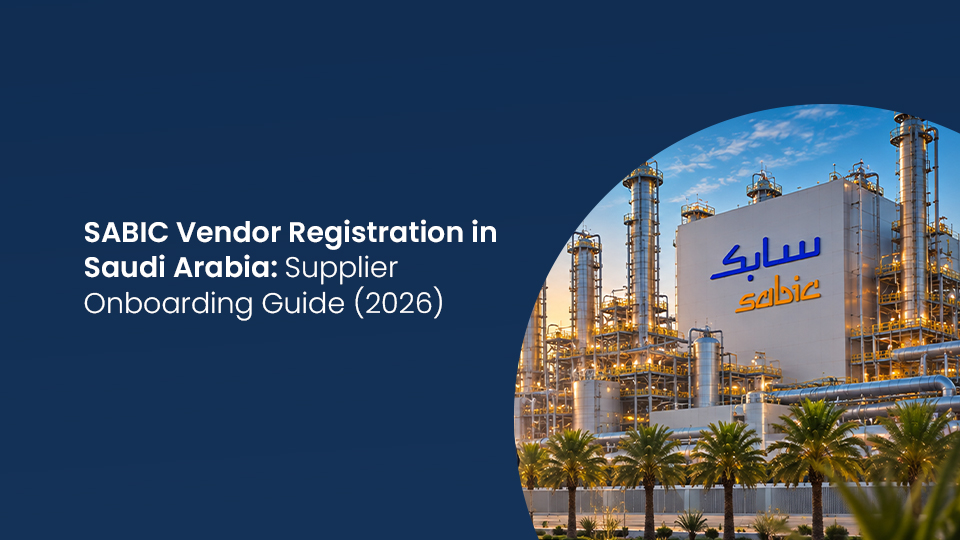
SABIC is one of the world’s largest diversified chemical companies and among Saudi Arabia’s biggest industrial procurers, sourcing petrochemical feedstock and equipment, manufacturing inputs, engineering and maintenance services, and specialised industrial solutions across its Saudi and global operations. SABIC’s own supplier portal frames registration around its stated ambition to be the preferred world leader in chemicals, and says explicitly that suppliers are evaluated on more than price and quality — safe working conditions, ethical conduct, and environmentally responsible practice are part of the assessment for every applicant.
For a business that wants to supply SABIC, that means registration isn’t a formality to get through quickly. It’s the mechanism SABIC uses to decide who is even eligible to be considered for sourcing events, and skipping or rushing any of the 3 steps below is the most common reason applications stall.
Who Can Register as a SABIC Supplier
SABIC’s registration process is open to manufacturers and industrial suppliers, service providers and contractors, distributors and logistics providers, and specialised solution providers and technical consultants. Eligibility is assessed against the goods or services offered, financial stability, quality standards, and relevant industry experience, gathered through the Company Classification and Scope of Supply step within Step 1 below.
Foreign companies can register, but — consistent with how Aramco, SEC, and Maaden registrations work in the Kingdom — moving through qualification generally requires a licensed local presence. If you haven’t yet set up a legal entity in Saudi Arabia, the business setup in Saudi Arabia guide covers the MISA licensing and formation process most foreign suppliers go through first.
SABIC Vendor Registration: The 3-Step Process
SABIC’s own Supplier Portal lays out registration as exactly 3 steps, each with a stated purpose and a defined scope of work. The summary below follows that structure directly.
Step 1 — Profile Creation & Due Diligence Assessment
This step builds a comprehensive supplier profile confirming your company’s commitment to SABIC’s Supplier Code of Conduct — covering ethical, safety, security, environmental, and labor standards, and anti-corruption principles. It covers: Company Details, Bank Details, Ownership Details, Company Hierarchy, Company Classification & Scope of Supply, the SABIC Due Diligence Questionnaire, and Required Documentation. Registration starts through SABIC’s Ariba self-registration portal, and the due diligence assessment itself is run in partnership with Achilles, SABIC’s third-party due diligence provider — Achilles offers a Quick Start Guide, webinars, and one-to-one appointments for suppliers who need help with the questionnaire, reachable at sabic@achilles.com or +44 (0)1235 861118 (UK) / +1-281-809-4400 (USA).
Step 2 — Technical Qualification
SABIC uses the information submitted in Step 1 to determine the level of technical qualification required and to confirm your company has the technical capabilities that meet SABIC’s standards and mitigate operating risk. A site visit is conducted if SABIC determines one is required for your category.
Step 3 — Supplier Onboarding
Once qualified, you receive two notification emails granting access to SABIC’s E-Business Portal, where you can receive requests for bid and submit bids online, view and accept purchase orders, and submit invoice data to facilitate payment. This is also where you can amend your supplier details going forward.
Two points SABIC states explicitly on its own portal: a SABIC Vendor ID is only issued once all 3 steps above are complete, not at initial submission — and completing the Supplier Registration Process does not guarantee business with SABIC. Registration makes you eligible to be considered; it doesn’t commit SABIC to any specific volume or timeline of work.
UPDATED CONTENT
SABIC only issues a Vendor ID after you successfully complete all three stages of registration: Due Diligence, Technical Qualification, and Onboarding.Completing registration does not mean SABIC will automatically give you contracts, RFQs, purchase orders, or any guaranteed amount of business. It simply means you become eligible to be considered as a supplier.
Documents to Prepare Before You Start
SABIC’s own portal groups documentation under Company Details, Bank Details, Ownership Details, Company Hierarchy, and Required Documentation in Step 1. The specific certificate list below reflects the standard KSA corporate-vendor document set — corroborated by third-party advisory sources and consistent with what Aramco, SEC, and Maaden request for their own registrations — rather than an itemized list SABIC’s own page publishes directly, so confirm exact requirements against your Ariba application checklist once you begin.
- Valid Commercial Registration (CR) Certificate
- Industrial License Certification (manufacturers only)
- VAT / ZATCA Registration Certificate
- GOSI (General Organization for Social Insurance) Registration Certificate
- Company Ownership Profile with supporting documents
- Authorized Signatory Letter identifying employees dealing with SABIC
- Bank reference letter describing your banking relationship
- Acknowledgment of the SABIC Supplier Code of Conduct
Manufacturers should have their industrial licensing in order before applying — our industrial license guide for foreign manufacturers covers that process end to end, and if SABIC’s classification review points toward a physical production presence in the Kingdom, our factory setup in Saudi Arabia guide covers site selection, licensing, and setup costs.
SABIC's Cyber Trust Program
Suppliers connecting to SABIC’s IT/OT systems or handling sensitive company data go through an additional track: the Cyber Trust Program, confirmed on SABIC’s own supplier portal. It runs on a 2-year certificate validity cycle and requires a supplier self-assessment followed by review from an authorized audit firm, with SABIC requiring 100% compliance with its cybersecurity requirements before the certificate is issued. This runs alongside, not instead of, the 3-step registration process above — it’s a separate compliance track relevant specifically to suppliers whose scope of supply touches SABIC’s digital or operational technology environment.
SABIC Supplier Portal Links at a Glance
New: SABIC splits registration and ongoing supplier management across a small set of distinct portals rather than one single login — worth knowing before you start so you use the right link at each stage.
| Portal / Link | Use It For |
|---|---|
| Ariba self-registration | Starting Step 1 — new supplier profile creation and due diligence questionnaire |
| Ariba supplier profile | Managing and updating an existing supplier profile after initial registration |
| E-Business Portal | Step 3 access — bidding, purchase order management, invoice submission |
| Achilles due diligence support | Help with the Step 1 questionnaire — webinars, one-to-one appointments, phone/email support |
| Supplier Registration Services contact | General registration queries directly to SABIC's supplier registration team |
Fees and Approval Timeline
SABIC’s own portal doesn’t publish a registration fee or a fixed approval timeline. Third-party advisory sources report that registration on the portal itself is typically free, with approval timelines ranging from a few weeks to a few months depending on documentation completeness, compliance checks, and category complexity — treat this as a general planning range rather than a SABIC-confirmed figure, and budget extra time if your category requires the Cyber Trust Program or a Step 2 site visit.
SABIC vs. Aramco vs. Maaden Vendor Registration
All three are large Saudi procurers with their own registration systems, but the entry point and structure differ enough that assuming one process transfers to another causes real delays.
| SABIC | Saudi Aramco | Maaden | |
|---|---|---|---|
| Registration system | SAP Ariba + Achilles due diligence | SAP Ariba | Oracle Cloud Supplier Portal |
| Registration structure | 3 steps: Due Diligence, Technical Qualification, Onboarding | Commodity-code categorisation + IKTVA scoring | 8-category supplier-type questionnaire |
| Sector focus | Petrochemicals, manufacturing, industrial equipment | Oil, gas, petrochemicals | Mining, minerals, metals processing |
| Extra compliance track | Cyber Trust Program (2-year cycle, IT/OT suppliers) | IKTVA local content scoring | Tharwah local content program |
If oil and gas or mining are also part of your target market, our Aramco vendor registration guide and Maaden vendor registration guide cover those processes in full. SABIC is also one of seven portals covered at a higher level in our vendor registration in Saudi Arabia overview, alongside Etimad, Aramco, SEC, DGA, Monsha’at, and Maaden.
Common Registration Mistakes
- Leaving the Achilles due diligence questionnaire incomplete. It’s the foundation of Step 1, and an incomplete profile blocks Technical Qualification entirely.
- Assuming registration alone secures business. SABIC states directly that completing the process does not guarantee contracts — approval depends on ongoing sourcing needs in your category.
- Applying as a manufacturer without a valid Industrial License Certification, which SABIC’s Company Classification step specifically screens for.
- Not budgeting time for a possible Step 2 site visit, which can extend the technical qualification timeline beyond a purely desk-based review.
- Overlooking Cyber Trust Program requirements for categories that touch SABIC’s IT/OT systems — this runs on its own 2-year cycle, separate from core registration renewal.
How Analytix Supports SABIC Vendor Registration
Getting the Step 1 profile and due diligence questionnaire right the first time avoids the delays that come from a returned or incomplete application. As part of our GRO services work, we help suppliers prepare the document package, complete the Company Classification and Scope of Supply step accurately, and work through the Achilles due diligence questionnaire before submission — grounded in Saudi-specific compliance requirements (CR, ZATCA, GOSI) rather than a generic checklist. For background on SABIC as a company beyond the supplier process, see SABIC’s corporate profile.
- FAQs
Frequently Asked Questions
The following questions cover the most common queries we receive from foreign investors about commercial registration in Saudi Arabia.
How do I register as a SABIC vendor or supplier?
Start through SABIC’s Ariba self-registration portal to complete Step 1, Profile Creation and Due Diligence Assessment, which includes company, bank, and ownership details plus a due diligence questionnaire run with Achilles, SABIC’s third-party partner. Step 2 is Technical Qualification, and Step 3 grants E-Business Portal access once you’re onboarded.
How long does SABIC vendor registration take?
SABIC’s own portal doesn’t publish a fixed timeline. Third-party sources report approval can range from a few weeks to a few months depending on how complete your documentation is, compliance checks, and category complexity — a Step 2 site visit or Cyber Trust Program requirement can extend this further.
Does SABIC vendor registration guarantee I'll receive contracts?
No. SABIC states explicitly on its supplier portal that completing the Supplier Registration Process does not guarantee business with SABIC. You only receive a Vendor ID once all 3 steps are complete, and future opportunities depend on SABIC’s ongoing sourcing needs.
What is the SABIC Cyber Trust Program?
It’s a separate compliance track for suppliers connecting to SABIC’s IT/OT systems or sensitive data, confirmed on SABIC’s own supplier portal. It requires a self-assessment reviewed by an authorized audit firm, 100% compliance with SABIC’s cybersecurity requirements, and renews on a 2-year cycle.
Can foreign companies register as SABIC suppliers?
Yes, foreign companies can register, but moving through qualification generally requires a licensed local presence in Saudi Arabia, consistent with how Aramco, SEC, and Maaden registrations work in the Kingdom.
What documents does SABIC require for vendor registration?
Commonly required documents include a valid Commercial Registration certificate, Industrial License Certification for manufacturers, VAT/ZATCA registration, GOSI registration, a company ownership profile, an authorized signatory letter, a bank reference letter, and acknowledgment of SABIC’s Supplier Code of Conduct.
What is Achilles and why does SABIC use it?
Achilles is SABIC’s third-party due diligence provider. It supports the Step 1 due diligence questionnaire and offers suppliers a Quick Start Guide, webinars, and one-to-one appointments to help complete profile verification.
What's the difference between SABIC, Aramco, and Maaden vendor registration?
SABIC uses SAP Ariba plus Achilles due diligence across a 3-step process (Due Diligence, Technical Qualification, Onboarding); Aramco uses SAP Ariba with commodity-code categorisation and IKTVA local-content scoring; Maaden uses its own Oracle Cloud Supplier Portal with an 8-category supplier-type questionnaire and the Tharwah local content program.
Does Analytix help with SABIC vendor registration?
Yes. Analytix supports document preparation, the Company Classification and Scope of Supply step, and the Achilles due diligence questionnaire as part of its GRO services.
Start Your SABIC Vendor Registration
SABIC’s 3-step process rewards a well-prepared first submission far more than a fast one — an incomplete due diligence questionnaire or a missing Industrial License Certification is the most common reason applications stall in Step 1. If you’re preparing a SABIC supplier application, talk to our consulting team before you submit.