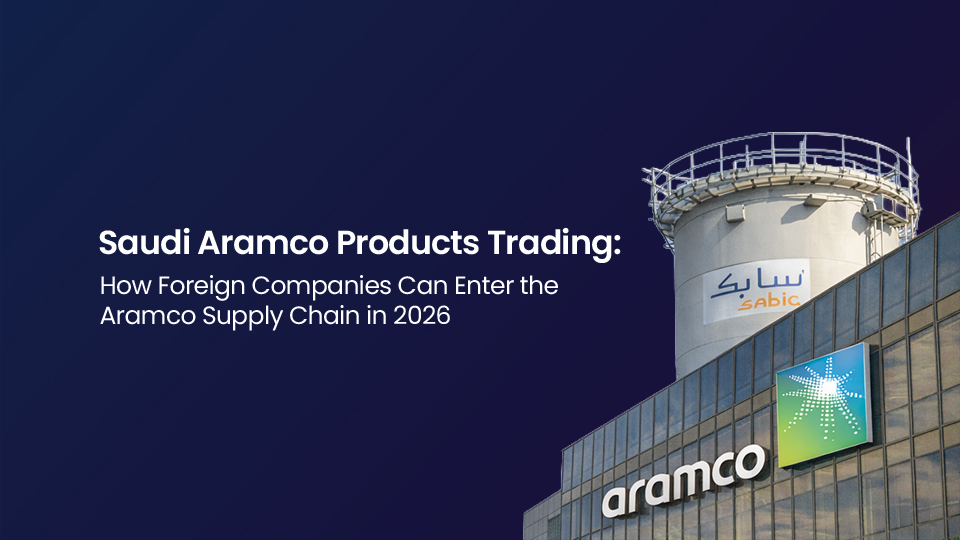
Saudi Aramco Products Trading: The Opportunity Most Foreign Companies Miss
Saudi Aramco products trading represents one of the most significant commercial opportunities in the global energy sector, and most foreign companies do not know how to access it.
Saudi Aramco is the world’s most profitable energy company, generating over $400 billion in annual revenue. Its trading arm, the Aramco Trading Company (ATC), moves crude oil, refined fuels, petrochemicals, and lubricants across global markets every single day.
The good news: foreign companies can participate. The barrier is not eligibility; it is knowing the process.
Can Foreign Companies Trade with Saudi Aramco?
Yes — foreign companies can trade with Saudi Aramco by setting up a legal entity in Saudi Arabia, registering on the SAP Ariba portal, and meeting IKTVA requirements.
However, success depends on proper planning, compliance, and local presence.
What Is the Aramco Trading Company?
The Aramco Trading Company (ATC) is Saudi Aramco’s wholly-owned trading subsidiary, responsible for buying, selling, and distributing petroleum products, petrochemicals, and refined fuels across global markets.
Founded in 2012 and headquartered in Riyadh, ATC operates global trading hubs in Singapore, Rotterdam, and Houston. It is the primary commercial interface between Saudi Aramco and international buyers, suppliers, and trading partners. For foreign companies looking to enter Saudi Aramco products trading, ATC is the entity you are dealing with, not the parent company directly.
What Products Does Saudi Aramco Trade?
The scope of Aramco Petroleum Products Trading is wider than most foreign companies realise. Saudi Aramco is the world’s largest crude exporter, but the product range extends well beyond crude oil.
| Product Category | Key Products | Who Buys These | Trade Route |
|---|---|---|---|
| Crude Oil | Arab Light, Arab Heavy, Arab Medium | Refineries, Energy Traders | Global |
| Refined Products | Diesel, Gasoline, Jet Fuel, Fuel Oil | Distributors, Governments | Asia, Europe, Americas |
| Petrochemicals | Ethylene, Propylene, Polyethylene | Manufacturers, Chemical cos. | Asia, Americas |
| LPG | Propane, Butane | Industrial, Residential buyers | South Asia, East Africa |
| Lubricants & Base Oils | Havoline, Industrial Base Oils | Auto sector, Industry | MENA, Global |
These estimates are based on publicly available Saudi Aramco procurement guidelines, IKTVA programme data, and MISA foreign investment regulations as of 2026.
How Does the Saudi Aramco Supply Chain Work?
Understanding the Aramco supply chain in Saudi Arabia is essential before attempting to enter it. Aramco operates across three layers: upstream production, midstream processing, and downstream trading and distribution. Foreign companies plug in almost exclusively at the downstream and services level.
What Is IKTVA and Why Does It Matter?
Saudi Aramco’s In-Kingdom Total Value Add (IKTVA) programme requires suppliers to progressively source goods, services, and labour from within Saudi Arabia targeting 70% local content by 2030. This is not a barrier for foreign companies. It is actually an invitation: Aramco actively wants foreign businesses to set up operations inside the Kingdom to meet this target. Foreign companies that establish a Saudi entity and hire locally score higher on IKTVA assessments and win more contracts.
Where Foreign Companies Can Enter the Aramco Supply Chain?
- Direct product trading — buy or sell crude and refined products through ATC
- Service vendor — supply equipment, technology, or maintenance services
- Petrochemical distribution — source and distribute Aramco petrochemical products
- Joint venture with a Saudi partner — boosts IKTVA score and local market access
Who Is Eligible to Become a Saudi Aramco Supplier?
Not every company can immediately qualify for Aramco vendor registration.
To become a Saudi Aramco supplier, foreign businesses typically need:
- A registered legal entity in Saudi Arabia (LLC, branch, or joint venture)
- Valid Commercial Registration (CR)
- Financial stability and audited statements
- Industry certifications
- Ability to meet IKTVA localisation requirements
Companies without a Saudi presence cannot complete vendor registration.
How to Become a Saudi Aramco Supplier: Step-by-Step
To become a Saudi Aramco supplier, a foreign company must first establish a legal entity in Saudi Arabia, complete the Aramco vendor registration on the SAP Ariba portal, pass technical and financial pre-qualification, and meet IKTVA localisation requirements.
| Step | Action Required | Who Handles It | Typical Timeline |
|---|---|---|---|
| 1 | Establish a legal entity in Saudi Arabia (LLC or Branch) | Analytix — full company formation support | 2–4 weeks |
| 2 | Register on Aramco's SAP Ariba Vendor Portal | Company + Analytix PRO support | 1–2 weeks |
| 3 | Submit pre-qualification documents (financials, certifications) | Company finance/legal team | 2–4 weeks |
| 4 | Technical evaluation by Aramco category team | Aramco internal | 4–8 weeks |
| 5 | IKTVA assessment — demonstrate local content commitment | Aramco + company | Ongoing |
| 6 | Approved Vendor list (AVL) — receive supplier status | Aramco internal | Variable |
Step 1 is where most foreign companies lose time.
You cannot complete vendor registration in Saudi Arabia without a valid Commercial Registration (CR) number first. Getting that CR along with your MISA licence and municipality approvals is exactly what Analytix handles.
To obtain a CR, companies must complete:
- MISA investment licence
- Company registration
- Municipality approvals
This is exactly where delays happen.
Analytix handles:
- Company formation in Saudi Arabia
- MISA licensing
- Commercial Registration (CR)
- Municipality approvals
- PRO services
- GRO services
This ensures your business becomes Aramco vendor-ready faster
One insight we keep seeing is that foreign companies often focus on getting access to the opportunity, but the real advantage comes from understanding how Saudi buyers source, qualify, and retain suppliers. The companies that perform better are usually the ones that adapt their offering to local procurement expectations, not just their pricing.
Documents Required for Aramco Vendor Registration
Before starting SAP Ariba registration, companies must prepare:
- Commercial Registration (CR)
- MISA investment licence
- Audited financial statements
- Company profile
- Certifications (ISO, etc.)
- IKTVA compliance plan
Preparing these in advance significantly reduces delays.
Setting Up a Company in Saudi Arabia to Trade with Aramco
Saudi Arabia now allows 100% foreign ownership in most sectors. That means a foreign company can register an LLC, complete business setup in Saudi Arabia, and begin the Aramco vendor registration process without needing a local partner, though having local operations improves your IKTVA score significantly.
| Structure | Best For | Foreign Ownership | Setup Time |
|---|---|---|---|
| LLC (WLL) | Trading, Services, Distribution | Up to 100% | 3–6 weeks |
| Branch Office | Representing parent company | 100% (branch) | 4–8 weeks |
| Joint Venture | IKTVA boost + local market access | Up to 75% | 6–12 weeks |
| Regional HQ | MENA operations hub | 100% | 8–12 weeks |
The fastest and most common route for foreign Aramco suppliers is LLC company formation in Saudi Arabia. An LLC gives you a Saudi CR number, MISA investment licence, and the legal standing to register on Aramco’s vendor portal, all within 3 to 6 weeks when handled correctly.
Saudi Aramco Business Opportunities for Foreign Companies in 2026
Saudi Aramco business opportunities are expanding faster than at any point in the last decade. Saudi Arabia’s Vision 2030 strategy is pushing Aramco to diversify its supplier base, upgrade its technology infrastructure, and grow domestic manufacturing capacity. These are the highest-demand categories right now:
- Oilfield services and equipment — Aramco’s single largest procurement category
- Energy technology and digital transformation — over $3 billion committed through 2030
- Petrochemical manufacturing and distribution — linked to SABIC partnership products
- Logistics, shipping, and storage — supporting Aramco’s global trading volume
- Environmental services and clean energy — growing with Aramco’s net-zero commitments
Companies that combine expansion and restructuring support in Saudi Arabia with a clear Aramco vendor strategy are best positioned to win contracts in these sectors. The key is having your Saudi legal entity, compliance, and local operations in place before bidding.
Why Riyadh Is the Best Location for Aramco Suppliers
Riyadh is the primary hub for Aramco and government entities.
Benefits:
- Proximity to decision-makers
- Faster approvals
- Better networking
- Strategic positioning
Many successful suppliers base their operations in Riyadh.
Saudi Aramco vs Other GCC Energy Companies: Trading Comparison
| Company | HQ | Products Traded | Foreign Co. Setup Required | Vendor Portal |
|---|---|---|---|---|
| Saudi Aramco (ATC) | Riyadh, KSA | Crude, Refined, Petrochemicals, LPG | KSA legal entity required | SAP Ariba |
| ADNOC Trading | Abu Dhabi, UAE | Crude, LNG, Refined products | UAE entity or approved | ADNOC Supplier Portal |
| QatarEnergy | Doha, Qatar | LNG, Crude, Petrochemicals | Qatar entity often needed | Own Portal |
| Kuwait Petroleum | Kuwait City | Crude, Refined products | Kuwait entity preferred | KPC portal |
Pros and Cons of Trading with Saudi Aramco as a Foreign Company
| Pros | Challenges |
|---|---|
| World's most profitable energy company — unmatched scale and stability | KSA legal entity required before vendor registration begins |
| Long-term supply contracts — multi-year deals with predictable revenue | IKTVA local content requirements add operational complexity |
| Vision 2030 actively opening KSA to more foreign participation | SAP Ariba pre-qualification can take 3–6 months |
| 100% foreign ownership now allowed in most sectors | High financial and technical qualification bar for AVL approval |
| Riyadh is a strategic hub for MENA and Asian energy markets | Arabic documentation required in some procurement categories |
| MISA fast-track licensing available — faster setup than 5 years ago | Cultural and regulatory differences from Western market norms |
Common Mistakes Foreign Companies Make
Many companies face delays due to avoidable mistakes:
- Starting vendor registration without a Saudi entity
- Delaying IKTVA planning
- Choosing wrong structure (branch vs LLC)
- Incomplete documentation
- Ignoring Saudi compliance (MISA, ZATCA)
Planning your market entry strategy in advance improves success rates significantly.
How to Save Time and Cost When Entering the Aramco Supply Chain
Most delays happen before a company even submits its first vendor application. Here is how to avoid the most common ones:
- Start company formation and pre-qualification documents in parallel — do not wait for your CR before preparing vendor documents
- Choose LLC structure over a branch office — faster Aramco vendor approval in most categories
- Use a PRO services provider in Saudi Arabia from Day 1 iqama, work permits, and municipality compliance handled for you
- Pair this with GRO services in Saudi Arabia to manage your ongoing government relations and licence renewals without internal headcount
- Engage an IKTVA consultant early local content strategy affects your vendor score before you even apply
- Get your accounting and bookkeeping services in Saudi Arabia set up from the start. Aramco’s pre-qualification requires audited financial statements
- Base in Riyadh’s proximity to Aramco HQ accelerates relationship-building and contract discussions
Is Saudi Aramco Trading Right for Your Business?
| Your Business Type | Aramco Opportunity | Recommended Analytix Service |
|---|---|---|
| Energy trader — crude/refined products | Direct buyer relationship with ATC | Company formation + vendor registration |
| Oilfield services / equipment supplier | Largest Aramco procurement category | LLC setup + PRO & GRO services |
| Technology / software company | Aramco's $3B digital transformation budget | MISA tech licence + company setup |
| Petrochemical manufacturer or distributor | Strong demand via Aramco/SABIC network | Trading company formation |
| Logistics / shipping company | Supporting Aramco's global trading volume | Branch office or LLC setup |
| Industrial manufacturer | Factory supply to Aramco and contractors | Factory setup in Saudi Arabia |
If your business falls into any of these categories, the factory setup in Saudi Arabia or the trading company formation path gives you the fastest route to Aramco vendor eligibility.
- FAQs
Frequently Asked Questions
If your question is not addressed here, please feel free to reach out to us. We value your inquiry.
How do foreign companies do business with Saudi Aramco?
Foreign companies enter the Aramco supply chain by establishing a legal entity in Saudi Arabia, completing vendor registration in Saudi Arabia on the SAP Ariba portal, passing pre-qualification, and meeting IKTVA local content requirements.
What products does the Aramco Trading Company trade?
The Aramco Trading Company trades crude oil, refined petroleum products (gasoline, diesel, jet fuel), petrochemicals, LPG, base oils, and lubricants across global markets from hubs in Riyadh, Singapore, Rotterdam, and Houston.
Do I need a Saudi company to trade with Aramco?
Yes. In most vendor and supplier categories, Saudi Aramco requires foreign companies to have a registered legal entity in Saudi Arabia, either an LLC, branch office, or joint venture, before completing vendor registration.
What is the Aramco vendor registration process?
Aramco vendor registration is completed through the SAP Ariba portal. Companies must submit financial documents, capability statements, certifications, and an IKTVA local content plan. The full process typically takes 3–6 months.
How long does it take to become an Aramco-approved supplier?
From starting company formation in Saudi Arabia to receiving Approved Vendor List (AVL) status, the full process typically takes 4–9 months, depending on the procurement category and document readiness.
What is IKTVA and why does it matter for Aramco suppliers?
IKTVA (In-Kingdom Total Value Add) is Aramco’s local content programme requiring suppliers to progressively source goods, services, and labour from within Saudi Arabia. A higher IKTVA score improves your chances of winning Aramco contracts.
Can a 100% foreign-owned company trade with Saudi Aramco?
Yes. Saudi Arabia now allows 100% foreign ownership in most sectors under MISA licensing. A fully foreign-owned LLC can register as an Aramco vendor, though IKTVA scores favour companies with local operations and Saudi employment.
What sectors have the most Saudi Aramco business opportunities?
The highest-demand sectors for Aramco suppliers are oilfield services, energy technology, petrochemicals, logistics, environmental services, and digital transformation. Aramco has committed over $3 billion to technology investment through 2030.
How is Saudi Aramco different from the Aramco Trading Company?
Saudi Aramco is the parent company responsible for oil production, refining, and downstream operations. The Aramco Trading Company (ATC) is its wholly-owned subsidiary that specifically handles international buying, selling, and distribution of petroleum and petrochemical products.
How can Analytix help foreign companies enter the Aramco supply chain?
Analytix handles the complete Saudi Arabia entry process — from MISA licence and Commercial Registration to PRO services and vendor documentation support — so foreign companies can focus on winning Aramco contracts instead of navigating Saudi bureaucracy.
Ready to Enter the Saudi Aramco Supply Chain?
Setting up in Saudi Arabia and registering as an Aramco vendor involves multiple government bodies, MISA, ZATCA, the municipality, and Aramco’s own procurement team. Analytix has guided dozens of foreign companies through this exact process.