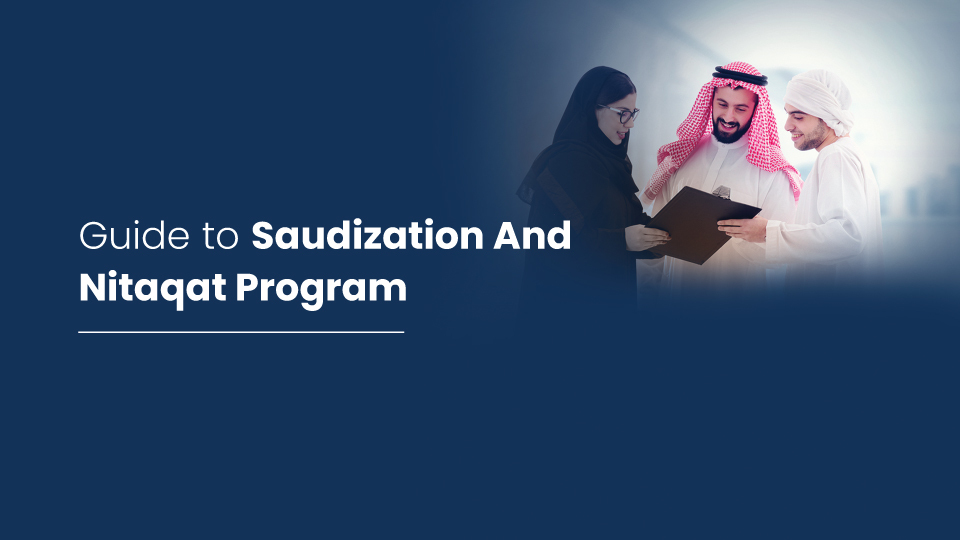
Any person or business looking to conduct business activities in Saudi Arabia needs an in-depth understanding of Saudization or the ‘Nitaqat Program’. This blog is designed to give you detailed information regarding this aspect. We will be discussing here what Saudization is, its importance, benefits, and requirements.
What is Saudization/Nitaqat?
Saudization refers to the Saudi Nationalisation Program, also known as Nitaqat. It makes it compulsory for businesses to reserve a fixed portion of jobs in the private sector for Saudi nationals. It was brought in to solve the employment challenges faced by Saudi nationals in the kingdom and improve their inclusion ratio in private sector jobs. The ratio of Saudization depends on the company size, the industry it operates in, and the business type.
Saudi Arabia has been growing substantially in recent years with both government and foreign investment flowing into the kingdom’s mega and giga projects. The Saudi Vision 2030 has pitched an ambitious economic diversification plan, with a significant role for the private sector to play. In this scenario, Saudization helps to ensure that Saudi nationals also benefit equally from the rise in private sector jobs and investment.
Saudization policy was first introduced in 1985 when Saudi Arabia was gaining wealth from oil exports and began to draw in foreign investment. It attracted expatriates from across the world for work and many set up their businesses. The Saudi government implemented Saudization to ensure that Saudi nationals had access to these upcoming jobs and opportunities.
The Saudi Ministry of Human Resources and Social Development (MHRSD) manages the Nitaqat system and established the compliance framework that companies need to adhere to. Under this system, companies are classified into six categories: Platinum, High Green, Medium Green, Low Green, Yellow, and Red, based on how well they meet their Saudization obligations. These classifications have a direct impact on your company’s ability to hire, sponsor, or renew visas for foreign workers.
Why Is Saudization Important?
Saudization plays a major role in ensuring that Saudi nationals are not excluded from private-sector employment in their own country. It is a landmark scheme that tries to distribute the benefits of private sector growth such as a skilled workforce, higher incomes, and better opportunities with the local population.
The Nitaqat Program also aims to solve a significant problem that the Saudi government has been facing. Traditionally, a high percentage of Saudi nationals were employed in the public sector. However, the government has not been able to absorb the increasing population into its workforce. The private sector must take in the increasing share of Saudi nationals seeking employment.
It is in line with the Saudi government’s push to diversify the economy from oil and create a thriving private sector to drive the economy forward.
What are the Benefits of Saudization?
Saudization has played a big role in enhancing Saudi nationals’ career opportunities, training, skill development, and professional growth. Let’s briefly discuss here the various benefits associated with Saudization:
1. Reduces Unemployment
The Nitaqat Program plays a significant role in keeping Saudi unemployment in check. With the labor force growing every year, the Saudization policy ensures that the expanding private sector continues to absorb Saudi workers and keep the unemployment rate as low as possible.
2. Development of Skilled Workforce
The inclusion of the local workforce into the private sector plays a prominent role in the development of a skilled Saudi workforce. They gain exposure to the latest best practices, trends, technologies, and upskilling programs.
3. Diversifying the Economy
Saudi Arabia has plans to diversify its economy to reduce its dependence on the oil sector. This will involve the development of the private sector, high-skilled labor, and entrepreneurship. Saudization plays an important role in improving the share of Saudi nationals in the private sector workforce and entrepreneurship.
4. Economic Growth
Saudization plays a significant role in boosting Saudi Arabia’s economic growth by reducing unemployment and increasing the share of income generated by Saudi nationals. It enables them to save, invest, and consume more products which increases domestic demand and stimulates economic growth.
5. Improves Social Stability
Saudization helps to maintain peace and stability in society by ensuring that the local population does not become hostile to migrant workers due to competition. By reserving a share of jobs for Saudis, citizens also get to enjoy a greater quality of life and well-being.
6. Builds Investor Confidence
The Nitaqat Program enhances investor confidence by paving the way towards a skilled workforce. Foreign investment and multi-national companies also help the local population enjoy best-in-class services and improve competition.
How Has the Concept of Saudization Developed Over Time?
The Nitaqat (quota) system has played a significant part in shaping the responsibilities of Saudi private-sector businesses. Saudi Arabia uses a rating system to determine how well different businesses follow the regulations set down as part of the Saudization program.
If a business is complying with Nitaqat, they are given positive ratings. Companies with the highest level of compliance are rated Platinum under the Nitaqat system. This gives them many benefits such as quick and streamlined immigration requests. The companies that have a poor record with Nitaqat compliance face many barriers including restrictions on employing new foreign workers.
In this manner, the Nitaqat program incentivizes private businesses to employ and train Saudi nationals while discouraging non-compliance. The system has undergone many revisions in recent years to align its objectives with Saudi Vision 2030.
To be more specific, the Nitaqat program categorises businesses into six bands: Platinum, High Green, Medium Green, Low Green, Yellow, and Red. Companies in the Platinum and Green bands enjoy smoother visa processing and fewer restrictions when accessing government services. In contrast, businesses classified as Yellow or Red may experience serious restrictions, such as being blocked from issuing new work permits or renewing current expatriate visas.
The difference in daily operations between a well-compliant and a poorly-compliant business can be quite large. Companies in the Platinum or Green bands usually benefit from faster visa processing, smoother labor approvals, and greater eligibility for government tenders. However, those in the Yellow or Red bands usually face issues like blocked visa renewals, hiring restrictions on expatriate workers, and overall reduced operational freedom.
How is the Percentage of Saudization Calculated?
The rate of Saudization that a company has to maintain is determined based on three factors:
- Total Number of Employees in the Company
- Type of Business Activity/ Sector of the Company
- Percentage of Saudi Employees in the Company’s Workforce
The Nitaqat Program also reserves certain employee positions for Saudi nationals. These include:
- The second employee who is hired after the General Manager for an international company expanding to Saudi Arabia must be a Saudi national.
- In a company with up to 5 employees, one needs to be a Saudi national.
- If a company has more than 100 employees, the Saudization rate must be at least 30%. This number can vary according to the sector or type of license.
The following positions are reserved for Saudi nationals under the Nitaqat Program:
- Senior HR Manager
- Personnel Specialist
- Recruitment Clerk
- Government Relations Officer
- Director of Labour Affairs
It is important to note that Saudi Vision 2030 prioritises boosting Saudi participation especially in the private sector. The key sectors for workforce localisation cover retail, tourism, logistics, construction, and technology, all of which have sector-specific Saudization targets related to this broader national agenda.
A common misconception most businesses have is that merely employing Saudi nationals is enough to meet their Nitaqat requirements. However, salary levels matter too. A Saudi employee earning less than SAR 4,000 per month counts as only 0.5 of an employee towards the Saudization quota, not as a full employee. This is a detail many companies miss, leading to compliance issues even when they think their employee count meets the necessary percentage.
To calculate your company’s Saudization percentage, first determine the total headcount registered on your labor file. Next, identify how many employees are Saudi nationals and verify their salaries meet the MHRSD eligibility threshold. By dividing the number of eligible Saudi employees by your total workforce, you will get your current Saudization ratio.
To understand this better, consider a company with 20 employees, of which only 2 are Saudi nationals, which results in a Saudization rate of 10%. Depending on the sector, this can land the business in a lower Nitaqat band. Increasing that number to 4 Saudi employees doubles the ratio to 20%, which in many sectors is sufficient to move the company into a better compliance category and facilitate easier access to labor services.
It’s essential to note that the required Saudization rate varies by industry. Sectors such as retail, HR, and customer service usually have higher Saudi employment targets, whereas industrial and technical sectors often have comparatively lower thresholds, mainly because they depend more on specialised expatriate skill sets.
What Are Other Important Things to Keep in Mind about Saudization?
- If your company does not meet the Saudization criteria, it will not be able to bid on public tenders and contracts.
- No different quotas for hiring men and women.
- If a Saudi national draws a salary of less than SAR 4,000, they will be counted only as 0.5 persons under the Saudization quota.
- Employing one Saudi national with disability counts as 4 persons under the Saudization quota.
- GCC Nationals are also counted under Saudization.
- If a Saudi national is registered as an employee under two different companies, they will be considered for the Saudization quota of only the first company.
Common Saudization Challenges Businesses Face
One common challenge is maintaining the Saudization percentage during business growth. When a company expands and hires more expatriate workers without a proportional increase in Saudi hires, the overall compliance ratio falls, which can unexpectedly push the business into a lower Nitaqat band. Management may not even realise this is happening.
It’s important to understand that Saudization is more than just hiring. Poor compliance standing can lead to issues with visa renewals, labor file management, government tender eligibility, and future expansion plans. Businesses that treat Saudization as a secondary concern instead of a key operational focus often find unnecessary delays in work permit processing and employee documentation renewals.
It is important to understand that Saudization is not a one-size-fits-all requirement. The required percentage will differ depending on factors like the applicable percentage differs depending on factors such as the company’s business activity, workforce size, regional classification, and overall employee composition. Before making major hiring or expansion decisions, businesses should check the latest MHRSD guidelines for current requirements.
Conclusion
We hope that you enjoyed reading our blog. Saudization is an important facet for businesses looking to expand into the Saudi market. We have tried to give you all the relevant details of the program, without making it an exhausting read. If you feel that we have missed out on something, do let us know. We will update our blog accordingly.
Need Help In Saudization?
Analytix can offer you strategic guidance to manage your Saudization in Saudi Arabia. We can help you with the Saudization process in Saudi Arabia.
Our Experience with Saudization Compliance
Our team has worked closely with businesses on labor compliance and MHRSD approvals, including everything from Nitaqat category improvements to employee quota management and sector-specific Saudization rates. We understand how workforce structure decisions, such as reserved job roles, can significantly affect a company’s compliance standing.
Our team has worked with companies across trading, consulting, contracting, manufacturing, and retail, assisting them in understanding their status under Nitaqat and actions required to improve their compliance position. This includes everything from workforce planning and labor file structuring to building practical Saudization strategies that withstand MHRSD review.
In our experience working with foreign investors in Saudi Arabia, workforce planning is often one of the most underestimated aspects of the process. Companies that address Saudization early, before serious hiring starts, usually face fewer issues when it’s time to manage visas, renewals, or pursue government approvals.
- FAQs
Frequently Asked Questions
If your question is not addressed here, please feel free to reach out to us. We value your inquiry.
What does Saudization mean for Expatriates?
Saudization affects expatriates seeking jobs in Saudi Arabia because it mandates companies to choose Saudi nationals for a certain number of job positions in the company.
What is the Saudization percentage?
The Saudization percentage refers to the ratio of Saudi nationals to the total number of workers employed in a particular sector or company.
What are the new Saudization rules for 2024?
If you are a private company employing five or more certified engineers, then the Saudization quota for your company will increase from 20% to 25% starting 21 July 2024.
How do you calculate Saudization?
Saudization is calculated as the percentage of Saudi nationals in the total workforce of the company.
What is a Saudization plan?
The Saudization plan refers to strategies that are planned to meet the Saudization requirements of a business.
What is the Saudization policy in Saudi Arabia?
The Saudization policy refers to a government initiative that mandates a certain proportion of employees in private-sector companies to be Saudi nationals.
What is the goal of the Saudization program?
The goal of the Saudization program is to ensure that Saudi nationals find equal opportunities in the private sector workforce.