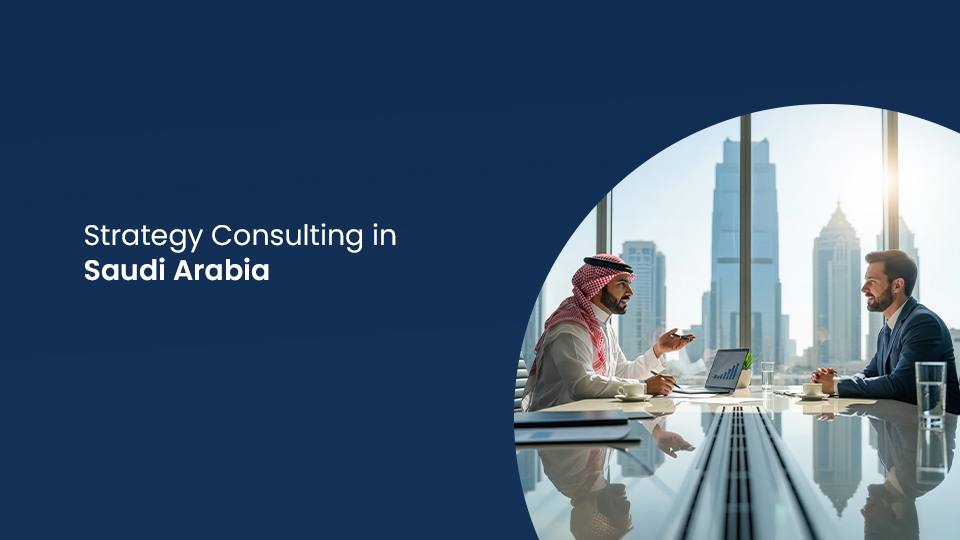
Plan your market entry, feasibility study, and growth strategy with a Saudi-based advisory team.
Quick Answer
Strategy consulting in Saudi Arabia is the work of planning how a business enters, expands, or repositions in the Kingdom before it commits capital: feasibility studies, market entry strategy, business planning, and cost optimization, built around Vision 2030’s foreign ownership and licensing rules.
Analytix’s strategy practice is led by Mohamed Afnas, Director of Strategic Consulting, and sits inside a firm that has run in Saudi Arabia since 2008, incorporated more than 2,500 companies, and operates across 8 countries.
What Strategy Consulting Actually Covers
Strategy consulting isn’t one service. At Analytix, it’s four things done together: a feasibility study that tests whether the idea works financially before you spend on licensing, a market entry plan that says which entity structure and which city, a business plan that turns both into a document banks and investors can act on, and a cost optimization pass that removes spend you don’t need before you scale.
Companies usually come to us at one of two points: before they’ve registered anything in Saudi Arabia, or after they’ve registered and hit a wall — the wrong entity type, an unclear go-to-market plan, or costs that crept up faster than revenue. Both are strategy problems, not paperwork problems.
Feasibility Studies Before You Commit Capital
A feasibility study answers one question with numbers: will this specific business, in this specific city, with this specific cost base, make money in Saudi Arabia within a defined timeframe. We build it from real inputs — sector-specific licensing costs, realistic hiring and Saudization requirements, rent and setup costs by city, and a demand estimate based on the market you’re actually entering, not a generic GCC average.
This is also the document that goes into your MISA licence application and any investor conversation. A feasibility study that’s vague in either direction — too optimistic or too conservative — costs you credibility with both.
Market Entry Strategy for Saudi Arabia
Saudi Arabia now permits 100% foreign ownership in most sectors, and licensing timelines have shortened considerably since Vision 2030 began. That doesn’t mean market entry is simple. It means the decisions that matter shifted: which entity type fits your model (a standalone LLC, a branch of your existing company, or a regional headquarters if you’re consolidating GCC operations), which city matches your customer base and supply chain, and which sector-specific rules apply before you can trade.
We map this against your actual business, not a template. A logistics company entering Dammam has a different entry path than a professional services firm entering Riyadh, even though both are “foreign company setup.”
Business Planning and Cost Optimization
Once the entry decision is made, the business plan is what turns strategy into an operating budget: capital requirements, hiring plan and Saudization ratio, a 12-to-36-month revenue and cost projection, and a funding or self-financing plan for the gap between setup and breakeven.
Cost optimization runs alongside this rather than after it. We look at where spend is duplicated across departments, where a process could run on fewer approvals, and where a service you’re paying a vendor for could be brought in-house once you’re past a certain headcount. This is the same discipline our team applies on the restructuring side of the business — see how strategy and restructuring connect below.
Who Leads Analytix's Strategy Practice
Mohamed Afnas is Analytix’s Director of Strategic Consulting. His team bio and LinkedIn profile are public at analytix.sa/about-us/ and linkedin.com/in/mohamed-afnas-a8940594. He also leads the Expansion & Restructuring practice, which is why the two service pages should cross-link — strategy consulting is the planning phase; restructuring covers what happens when an existing Saudi entity needs to reorganize.
Why Companies Choose Analytix for Strategy Consulting in Saudi Arabia
Analytix has run in Saudi Arabia since 2008, incorporated more than 2,500 companies, and operates across 8 countries — KSA, Qatar, Oman, UAE, India, China, the US, and the UK. The firm is Great Place to Work certified. Its client roster spans multinationals with a presence on analytix.sa, including ArcelorMittal, TATA Group, and Motherson Group, alongside a large base of SME clients across sectors.
A strategy consultant who only knows Saudi Arabia misses how a GCC-wide or global structure affects your entry decisions. A strategy consultant who only knows international markets misses Saudization, MISA licensing, and local sector rules. Analytix’s cross-border footprint means the same team can hold both.
Strategy Consulting Across the GCC: How Saudi Arabia Compares
Most companies planning a Saudi Arabia entry are also weighing Qatar, the UAE, or Oman, either as alternatives or as the next step after Saudi Arabia. Analytix operates in all four, so a Saudi strategy is built knowing how it fits, or doesn’t, with a wider GCC structure:
| Market | Foreign Ownership | Investment / Licensing Body | Workforce Nationalization |
|---|---|---|---|
| Saudi Arabia | Up to 100% in most sectors | MISA (Ministry of Investment) | Saudization (Nitaqat) |
| UAE | Up to 100% in most sectors (since 2022) | DET, formerly DED (per emirate) | Emiratisation |
| Qatar | Up to 100% in most sectors; full ownership via QFC or free zones | Ministry of Commerce and Industry (MOCI) | Qatarisation |
| Oman | Up to 100% across 2,000+ activities | MOCIIP | Omanisation |
The rules converge (all four now allow majority or full foreign ownership in most sectors) but the licensing bodies, timelines, and nationalization quotas don’t. A strategy built only around Saudi Arabia’s rules can create rework later if the same group later sets up in Doha or Dubai. This is why the market entry plan (above) accounts for the entity structure question early, not just the Saudi licence.
[CONFIRM before publishing: ownership rules and licensing-body names change; verify current requirements with each jurisdiction’s regulator before this table goes live, and re-check on a periodic basis after.]
How This Connects to Business Expansion and Restructuring?
Strategy consulting and business expansion and restructuring are two stages of the same relationship with Analytix. Strategy consulting is where a business decides how and where to enter or grow. Restructuring is what happens later, when an already-operating Saudi entity needs to reorganize — a new capital structure, a governance change, or a sale. Both sit under Analytix’s broader corporate services in Saudi Arabia.
- FAQs
Frequently Asked Questions
The following questions cover the most common queries we receive from foreign investors about commercial registration in Saudi Arabia.
What does a strategy consultant in Saudi Arabia actually do?
A strategy consultant runs the feasibility study, market entry plan, and business plan before you register a company, or diagnoses why an existing entry isn’t performing and resets the plan.
How much does strategy consulting cost in Saudi Arabia?
It depends on scope — a standalone feasibility study is a smaller engagement than a full market entry and business plan package. Book a consultation and Analytix will scope it against your specific business.
Do I need a feasibility study before applying for a MISA licence?
It’s strongly recommended. MISA reviewers and most banks expect a feasibility study or business plan alongside the licence application, and building one after the fact usually means redoing work under time pressure.
Can Analytix help if I've already registered a company in Saudi Arabia and the strategy isn't working?
Yes. This is one of the two common starting points — an existing entity with the wrong entry strategy is a diagnosis-and-reset engagement, not a from-scratch one.
What's the difference between strategy consulting and business restructuring?
Strategy consulting plans how you enter or grow. Restructuring reorganizes a business that’s already operating — its capital structure, governance, or ownership. Many clients use both at different points.
Which cities does Analytix's strategy team cover?
Dammam, Riyadh, and Jeddah, with the flexibility to support engagements anywhere in Saudi Arabia given the firm’s presence across all three.
Does Analytix help compare Saudi Arabia against other GCC markets before choosing where to expand?
Yes. Analytix operates in Saudi Arabia, Qatar, Oman, and the UAE, so the same team can compare ownership rules, licensing bodies, and nationalization requirements across markets before you commit to one.