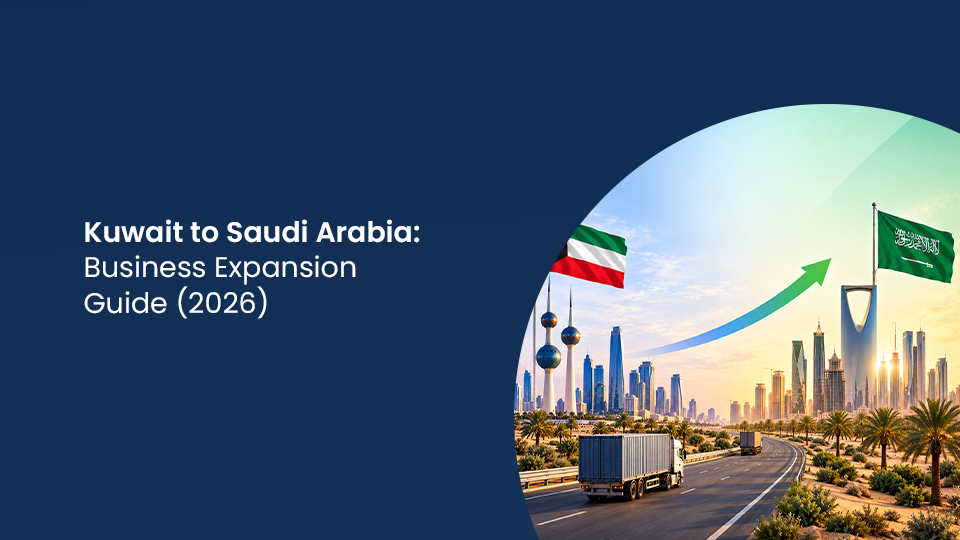
Al Khafji, on the Saudi side, and Al Nuwaiseeb, on the Kuwaiti side, form the only land border crossing between the two countries end it’s a working freight corridor, not a quiet checkpoint. Over 10,000 trucks crossed it in a single 25-day stretch in early 2026 alone. A joint feasibility study for a Riyadh-Kuwait high-speed rail link has now been approved, with construction set to begin in 2026. If you run a business in Kuwait, the infrastructure connecting you to Saudi Arabia’s Eastern Province is being actively built out right now, not just talked about.
This guide covers the Kuwait-specific case for expanding into Saudi Arabia and the registration path to get there. For the full mechanics of business setup in Saudi Arabia across every entity type, Analytix’s main business setup guide covers the broader picture.
Quick Answer
Kuwaiti nationals qualify for GCC national treatment in Saudi Arabia: no MISA investment license required, no minimum capital for most activities, freedom to operate in almost any sector, and 2.5% Zakat instead of the 20% corporate income tax non-GCC foreign investors pay. Kuwait and Saudi Arabia are also connected by the Al Khafji/Al Nuwaiseeb land border the only crossing between the two countries, handling over 10,000 trucks in a 25-day stretch in early 2026 and by a new Riyadh-Kuwait rail link now moving into construction, which together make the Eastern Province the natural first base for a Kuwaiti business entering Saudi Arabia.
Why the Kuwait-Saudi Corridor Is Being Built Out Right Now
The Al Khafji/Al Nuwaiseeb crossing is the only land link between Kuwait and Saudi Arabia, and it already carries real commercial volume over 10,000 trucks crossed in a single 25-day stretch in early 2026, moving freight between Kuwait’s Ahmadi Governorate and Saudi Arabia’s Eastern Province around the clock (Khaleej Cargo). Wait times run as low as 30 minutes on a quiet weekday morning, though Thursday and Friday evenings can stretch to 3-4 hours; post-reform crossing time for prepared cargo runs 4-8 hours end to end.
A second, much larger infrastructure shift is now underway: a joint Kuwait-Saudi committee has approved the financial, economic, and technical feasibility study for a dedicated rail link, with construction set to begin in 2026 (Gulf Construction Online). The planned high-speed passenger line runs from Al Shadadiya in Kuwait’s Al Farwaniya governorate to Riyadh roughly 500km covered in 100 minutes, projected to carry around 3,300 passengers a day once operational. It’s part of the wider 2,186km GCC Railway network, reported around 50% complete as of May 2026 and targeting full completion by December 2030; Saudi Arabia’s own 672km section of that network runs from Al-Khafji, right at the Kuwait border, down to Al-Batha at the UAE border.
None of this is a distant plan. It’s active construction and freight volume happening on a corridor a Kuwaiti business can already use today, with capacity and speed both improving over the next few years rather than staying flat.
A Relationship No Other GCC Pair Has: the Neutral Zone
Kuwait and Saudi Arabia share something unique among GCC neighbours: the Partitioned (Neutral) Zone, where the onshore Wafra field and offshore Khafji field are jointly operated rather than sitting on either side of a border. Wafra Joint Operations a partnership between Saudi Arabian Chevron and the state-owned Kuwait Gulf Oil Company restarted production at both fields on 1 July 2020 after they had been shut since 2014 and 2015. In May 2025, the two countries jointly announced a new oil discovery at the Wara-Burgan-1 well in North Wafra, the first find since the 2020 restart (World Oil).
For Kuwaiti businesses in energy services, oilfield equipment, drilling support, or engineering, that’s not background trivia it’s a live, binational operating zone that already requires suppliers and contractors comfortable working across both Kuwaiti and Saudi systems. Few Saudi market-entry stories start with an operational fact this specific to one GCC neighbour.
Kuwaiti Capital Already in the Saudi Market
Kuwait Projects Company Holding (KIPCO) holds a stake in SADAFCO, a food and dairy company listed on the Saudi Exchange with a market capitalisation of roughly US$2.4 billion a concrete, checkable example of Kuwaiti capital already built into the Saudi market rather than a theoretical opportunity (KIPCO corporate profile). Kuwait and Saudi Arabia also sit inside the GCC Customs Union, established in 2003, which applies a common 5% external tariff and allows free movement of goods between member states a structural advantage that lowers the friction of moving product across the Al Khafji corridor specifically.
What Kuwaiti Nationals Actually Get Under the GCC Economic Agreement
Analytix covers the full regulatory mechanics on our GCC nationals company registration guide – the version that matters for planning:
- No MISA investment license required.
- No minimum capital requirement for most business activities.
- Freedom to operate in almost any sector open to Saudi nationals.
- 2.5% Zakat instead of the 20% corporate income tax non-GCC foreign investors pay.
- 5% VAT applies regardless of nationality.
Company Structures Open to Kuwaiti Investors
As a GCC national, Kuwaiti investors can choose Sole Establishment, LLC, Joint Stock Company, General Partnership, or a Branch of a GCC Company covered in full in Analytix’s types of companies in Saudi Arabia guide. Given the trade and energy-services pattern across the Al Khafji corridor and the Neutral Zone, Kuwaiti oilfield services and logistics firms most often choose either an LLC for a standalone Saudi entity, or a Branch of a GCC Company when extending an existing Kuwaiti operation rather than incorporating fresh.
Sectors Where the Kuwait-Saudi Relationship Points
Energy services and oilfield support lead, driven directly by the Neutral Zone’s joint operations at Wafra and Khafji drilling support, equipment supply, and engineering firms already used to cross-border coordination have a natural entry point, and many go on to register as approved suppliers through Analytix’s vendor registration process once established.
Logistics and freight-forwarding is the second cluster, built directly on the Al Khafji/Al Nuwaiseeb corridor’s existing truck volume the same route the new rail link is being built alongside, not instead of.
Food, consumer goods, and manufacturing round out the third, following the precedent set by KIPCO’s stake in Saudi-listed SADAFCO. Kuwaiti manufacturers considering a physical production base in the Eastern Province, close to the Al Khafji crossing, can review Analytix’s factory setup guide for site selection and licensing.
Documents You'll Need
Analytix’s GCC nationals guide lists the core documentation, and for Kuwaiti applicants specifically it comes down to four items:
- A valid Kuwaiti passport.
- Your proposed company name, submitted in Arabic with its Arabic meaning.
- Kuwaiti national ID (Civil ID).
- A proposed business plan covering your intended activity and structure.
The Registration Path at a Glance
This is the same six-step process Analytix runs for every GCC national, condensed here so you know what to expect before you start:
| Step | What Happens |
|---|---|
| 1. Documentation | Attestation of your Kuwaiti passport, Civil ID, and business plan. |
| 2. Trade Name Reservation | Reserve your company name with the Ministry of Commerce, in Arabic. |
| 3. Commercial Registration | No MISA license needed -- Analytix registers you directly with the Ministry of Commerce. Registration is valid for one year and renewable. |
| 4. Articles of Association | Analytix drafts and attests your AoA. |
| 5. National Address | Register a physical or virtual office address -- a virtual package is a practical starting point if you're testing the market via the Al Khafji corridor before relocating staff. |
| 6. HRSD and GOSI Registration | Register with the Ministry of Human Resources and Social Development and the General Organization for Social Insurance so you can legally hire staff. |
What It Costs
Costs vary by business activity, structure, and whether you lease physical office space or start with a virtual address. Analytix’s cost calculator gives you an estimate in under a minute based on your specific activity worth running before you commit to a structure.
Analytix in the Eastern Province
For a Kuwaiti business, Analytix’s Dammam office is the closest point of contact on the Saudi side of the Al Khafji corridor. Our GCC-national registrations are supported by our wider office network across KSA, Qatar, Oman, UAE, India, China, and the UK.
- FAQs
Frequently Asked Questions
The following questions cover the most common queries we receive from foreign investors about commercial registration in Saudi Arabia.
Do Kuwaiti nationals need a MISA license to register a company in Saudi Arabia?
No. As GCC citizens, Kuwaiti nationals are exempt from the MISA investment license required of non-GCC foreign investors.
What is the only land border crossing between Kuwait and Saudi Arabia?
Al Khafji on the Saudi side and Al Nuwaiseeb on the Kuwaiti side form the sole land crossing between the two countries. It operates 24 hours a day and carried over 10,000 trucks in a single 25-day stretch in early 2026.
Is there a new rail link planned between Kuwait and Saudi Arabia?
Yes. A joint Kuwait-Saudi committee has approved the feasibility study for a high-speed rail line running roughly 500km from Kuwait to Riyadh in about 100 minutes, with construction set to begin in 2026 as part of the wider GCC Railway network.
What is the Saudi-Kuwait Neutral Zone?
It’s a jointly operated area containing the onshore Wafra and offshore Khafji oil fields, run by Wafra Joint Operations (Saudi Arabian Chevron and Kuwait Gulf Oil Company). Both fields restarted production in July 2020 after a shutdown, and a new oil discovery was jointly announced in May 2025.
What tax rate applies to a Kuwaiti-owned company in Saudi Arabia?
2.5% Zakat instead of the 20% corporate income tax non-GCC foreign investors pay. 5% VAT applies regardless of nationality.
Which sectors are Kuwaiti businesses best positioned to enter in Saudi Arabia?
Energy services and oilfield support (driven by the Neutral Zone’s joint operations), logistics and freight-forwarding along the Al Khafji corridor, and food, consumer goods, and manufacturing, following the precedent of Kuwaiti capital already in the Saudi market.
Can a Kuwaiti company open a branch in Saudi Arabia instead of a new company?
Yes. GCC nationals with an existing Kuwaiti company can register a Branch of a GCC Company, which operates under the parent company’s legal and financial backing rather than as a separate new entity.
Which Saudi city is closest to Kuwait for setting up a business?
The Eastern Province, near the Al Khafji border crossing, is the most practical base — Analytix’s Dammam office is the closest point of contact on the Saudi side.
Set Up Your Company in Saudi Arabia with Analytix
Analytix has supported GCC nationals through Saudi company registration for more than a decade, with a Dammam office positioned for Eastern Province and Al Khafji-corridor business. If you already know your structure and are ready to register, talk to our team.