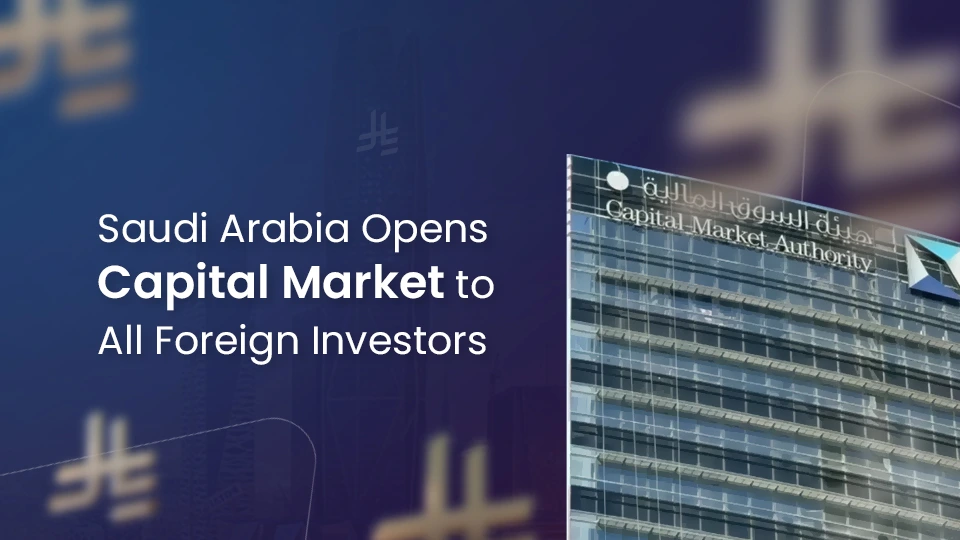
The Kingdom of Saudi Arabia has announced a major update for foreign investors. Tadawul, scrapping the Qualified Foreign Investor (QFI) framework. This means any foreign investor, regardless of size or category, can now directly invest across all market segments, reinforcing the Kingdom’s push toward investing in Saudi Arabia.
From February 1, 2026, Saudi Arabia opens capital market to foreign investors to directly invest in Tadawul without qualifying as Qualified Foreign Investors (QFIs).
To understand what this update means for investors and businesses and how to benefit from this opportunity when entering the Saudi market, explore foreign investment in Saudi Arabia.
What is the new update?
Saudi Arabia has eliminated the Qualified Foreign Investor (QFI) framework for the Main Market on Tadawul. Previously, foreign investors had to qualify as QFIs and meet strict eligibility criteria to access listed securities. This Saudi capital market reform represents a major shift in the way international investors in Saudi Arabia.
Under the previous regulations, QFIs were required to maintain around $500 million in assets under management to participate. From 1st February 2026, this requirement, along with similar thresholds, will be removed, allowing all categories of foreign investors to invest directly in listed shares. This market liberalisation Saudi Arabia initiative now allows global investors to access direct investment in Tadawul shares with fewer barriers.
What is Qualified Foreign Investor (QFI) Framework?
The Qualified Foreign Investor (QFI) framework previously restricted direct access to Saudi listed securities to large, approved foreign investors only. For many years, Saudi Arabia functioned under a Qualified Foreign Investor system. The significant change removes the QFI concept from the Main Market rulebook and the related eligibility criteria. This update allows individual investors, institutions, funds, and other non-resident investors to enter the market without needing any special qualification status. The Capital Market Authority Saudi Arabia (CMA) has implemented these changes to encourage more foreign investment in Saudi securities.
At the same time, the Capital Market Authority has eliminated the swap framework that allowed non-resident investors to gain only economic exposure to listed securities through swap agreements. From February 2026, investors will be able to hold direct legal titles to listed securities instead of relying on swaps to monitor performance. This brought a significant shift to Saudi capital market regulations, allowing real opportunities for foreign portfolio investment Saudi Arabia.
What’s the impact on Tadawul, liquidity, and Vision 2030?
Opening Tadawul to all foreign investors is expected to increase liquidity, improve price discovery, and support Saudi Vision 2030’s capital market goals. The entry of Tadawul foreign investors is expected to strengthen market depth and increase trading volumes. Deeper liquidity usually helps narrow spreads, support improved price discovery, and minimise day-to-day volatility over time, reflecting broader economic momentum seen in Saudi Arabia’s industrial growth, fueled by manufacturing.
This initiative aligns with the objectives of Saudi Vision 2030 by attracting additional international capital to support major projects and reduce the economy’s dependence on oil. These financial market reforms Vision 2030 aims to strengthen Riyadh’s status as a regional financial hub and make Tadawul one of the top emerging market exchange platforms globally. These efforts show the Kingdom’s dedication to attract Saudi stock market foreign investment and to be seen as a trusted, open market for international capital.
Comparing to July 2025 changes for GCC residents
The July 2025 changes applied only to select GCC-based investors, while the February 2026 reform opens the market globally. This decision is based on previous access changes in July 2025, when the CMA made it easier for specific categories of foreign investors to open accounts. These changes primarily focused on natural foreign investors residing in Gulf Cooperation Council (GCC) countries and individuals who lived in Saudi Arabia or another GCC country. Thus, the new regulations significantly expand beyond the GCC-focused adjustments and finalise the gradual opening process.
Which investors gain and what sectors may benefit
Individual investors, institutions, funds, and sovereign entities worldwide can now invest directly in Saudi-listed shares. Foreign investors who are not residents, global asset managers, financial institutions, pension & sovereign funds, and foreign legal entities that fulfill account-opening criteria through local intermediaries will have instant access to Main Market listed securities.
Sectors likely to attract the most foreign investment include financial services, petrochemicals, and large consumer and industrial companies already in major emerging-market indices. As fintech in Saudi Arabia grows and more listed securities come from digital and financial technology companies, the segment will also attract growing foreign interest.
| Aspect | Previous framework (QFI) | New framework from 1 Feb 2026 |
|---|---|---|
| Market access | Only Qualified Foreign Investors could invest directly in Main Market | All foreign investor categories can invest directly |
| AUM requirement | Minimum around 500 million USD AUM for QFIs | No specific AUM threshold for access |
| Use of swaps | Swaps used to give non-residents economic exposure only | Swap framework removed; direct share ownership allowed |
| GCC residents (July 2025) | Simplified account rules for certain GCC-based or ex-resident investors | Global opening, not limited to GCC-related categories |
| Regulatory authority | Capital Market Authority Saudi Arabia financial regulatory authority | Same authority, under updated rule set |
How to start trading on Tadawul?
Foreign investors can trade on Tadawul by opening an account with a licensed local broker and completing regulatory due diligence. To start trading on Tadawul from 1 February 2026, foreign investors will need to follow a structured investor journey that includes regulatory and compliance steps.
- Work with an authorised local broker or custodian to open an investment account
- Complete client due diligence and know-your-customer checks mandated by the financial regulatory authority
- Ensure internal compliance with home-country regulations and any cross-border reporting obligations
Investors need to check the CMA capital rules and FAQs about foreign investment in securities, which provide clear explanations for eligibility, account structures, and ongoing obligations in simple language. It’s also important to clarify tax implications in both Saudi Arabia and the investor’s home country, including any withholding tax on dividends or gains as well as treaty relief options.
How Analytix Can Support You?
Navigating Saudi Arabia’s capital market reforms requires regulatory clarity, market understanding, and local expertise.
The Saudi market opening offers a major opportunity for businesses wanting to expand their regional presence. Investors and businesses must understand the regulatory landscape and market dynamics.
Analytix works in this space by helping businesses expand their operations into international markets like Saudi Arabia. Our team provides practical guidance on market entry, regulatory compliance, and strategic planning. We understand how reforms like the capital market opening offer larger business opportunities in the region.
If you’re considering how this update aligns with your expansion plans, reach out to us, and we will help you assess the practical steps and requirements specific to your situation.
- FAQs
Frequently Asked Questions
If your question is not addressed here, please feel free to reach out to us. We value your inquiry.
Can foreigners invest in the Saudi stock market?
Yes, starting February 1, 2026, all types of foreign investors will be able to invest directly in the Saudi stock market, including the Main Market on Tadawul, as the Capital Market Authority has removed the Qualified Foreign Investor framework.
What is Tadawul in Saudi Arabia?
Tadawul, now referred to as Saudi Exchange, is the stock exchange in Saudi Arabia that manages the Main Market for listed securities; it started informal trading in 1954 and became a joint stock company in 2007.
What is a Qualified Foreign Investor (QFI)?
A Qualified Foreign Investor (QFI) refers to a large institution or fund that has approximately $500 million in assets under management and that meets CMA criteria to invest directly in Tadawul’s Main Market before the framework ended in 2026.
When did Saudi Arabia open its capital market to foreign investors?
Saudi Arabia initially allowed qualified foreign investors into its capital market in 2015, with additional steps in July 2025 for certain categories and full access for all foreign investors starting 1 February 2026.
Is Saudi Arabia open to foreign investors?
Yes, from 1 February 2026, Saudi Arabia will fully open its capital market to all foreign investors, allowing direct investment in Tadawul without prior qualification requirements.
What is the Capital Market Authority in Saudi Arabia?
The Capital Market Authority (CMA) is the financial regulatory authority in Saudi Arabia that manages the securities market, enforces regulations on brokers and funds, and maintains transparency and stability.
Do foreign investors need approval to invest in Tadawul?
No special approval like QFI status is needed from February 2026; foreign investors simply have to open an account with an authorised local broker, complete KYC checks, and follow standard regulations.
How does Saudi Vision 2030 affect foreign investment?
Reforms like market opening to attract foreign capital are efforts by the Saudi Vision 2030 to diversify the economy away from oil, and position Saudi Arabia as a global investment hub by making access easier and increasing liquidity.